CUDA Hardware RT Pathtracer
Wavefront GPU renderer with NEE + MIS, light linking, and physically based cameras
Overview
A wavefront path tracer in CUDA with OptiX hardware ray tracing, built for CIS 5650 GPU Programming and Architecture at the University of Pennsylvania (Project 3).
Source code on GitHub. Tested on Windows 11, AMD Ryzen 5950X @ 4.3GHz (PBO enabled), 64GB RAM (3200 MT/s), RTX 3090 24GB.
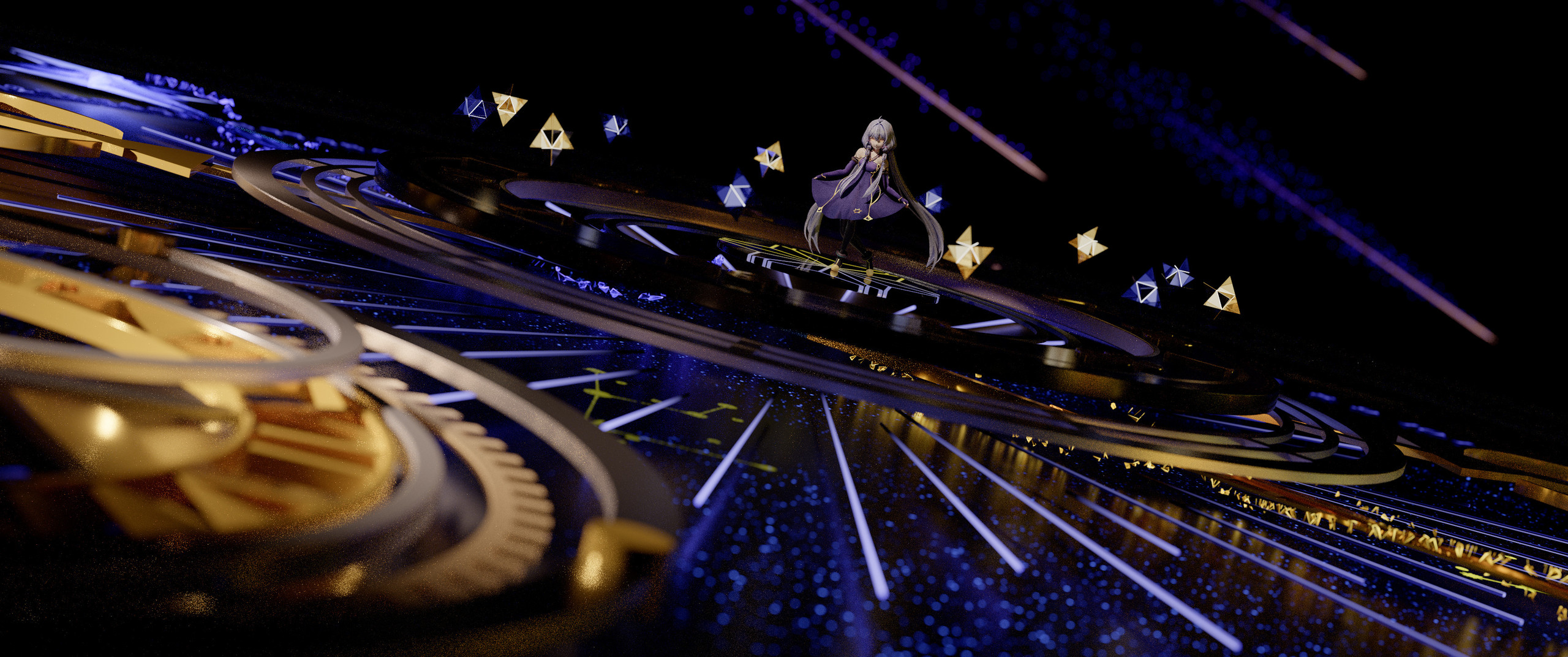
Stardust: my own Blender scene (8.8 M triangles, 2.4 M emissive, light linking). 3440x1440, 2048 spp, DEPTH 12, AgX, no denoising, 33.4 s on RTX 3090 (16.3 ms/sample).
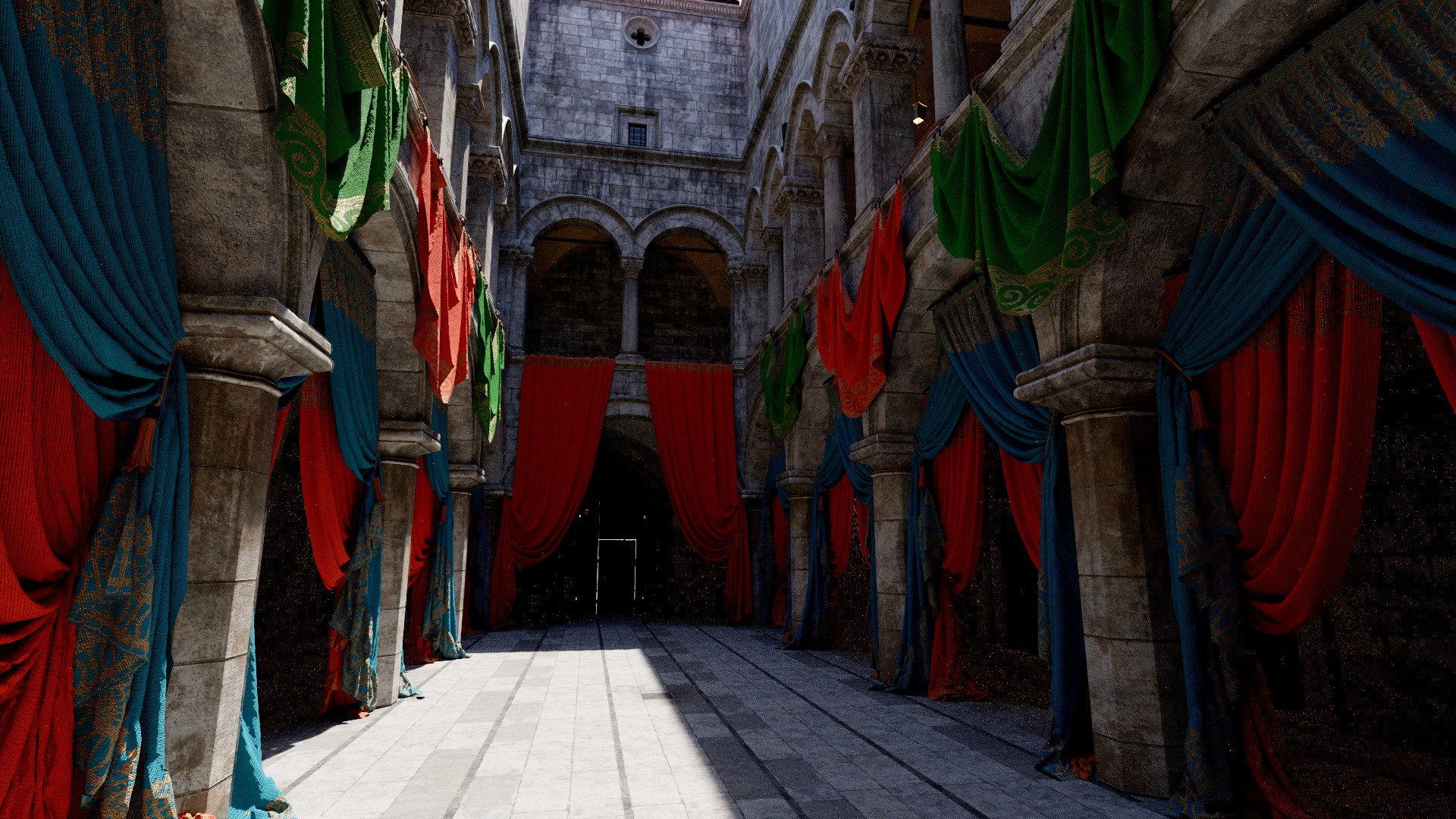
Sponza: Intel Sponza with the curtains package, 1920x1080, 1024 spp, DEPTH 8, AgX punchy, no denoising, 12.5 s on RTX 3090 (12.2 ms/sample).
Features
Rendering
- Wavefront path tracer on OptiX hardware ray tracing
- glTF scenes and meshes with textures and normal maps
- glTF metallic-roughness materials: transmission, volume absorption, clearcoat, specular, alpha mask and blend
- Next event estimation with MIS over emissive meshes and point, spot and directional lights
- Blender light linking
- Importance-sampled environment maps with MIS compensation
- Thin lens depth of field and stochastic antialiasing
- AgX and ACES view transforms
- Physically based camera and lens system: work in progress.
Performance
- Stream compaction inside the shade kernel with warp-aggregated atomics
- Material sorting with a CUB radix sort (optional)
- Russian roulette
- Device link-time optimization
Other
- Unreal-style viewport camera and scene switching in ImGui
- Headless rendering from the command line
Rendering pipeline
The renderer is a wavefront path tracer: each stage of a bounce is one launch over every live path, and paths that end are compacted away. Intersection runs on OptiX hardware ray tracing.
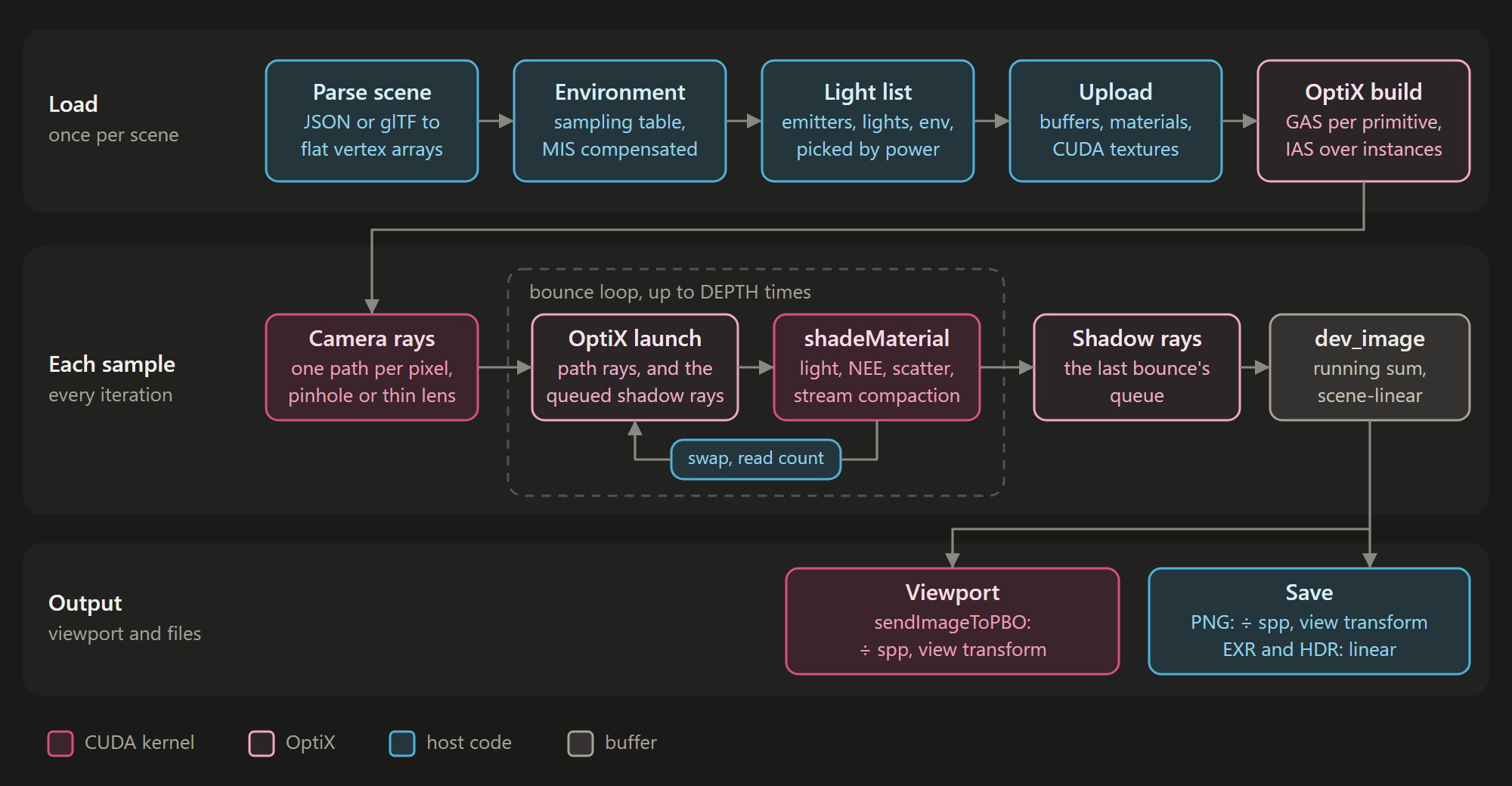
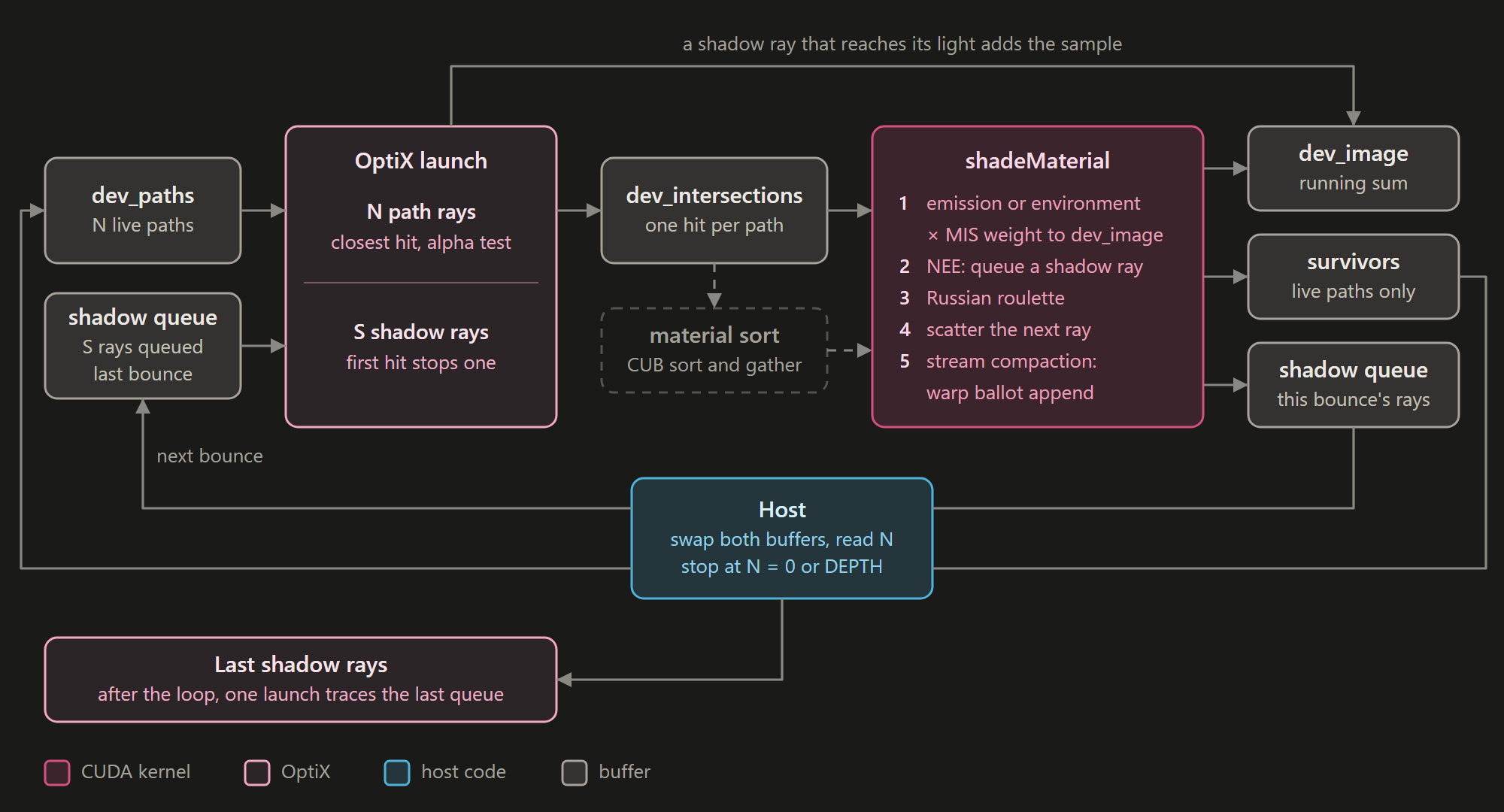
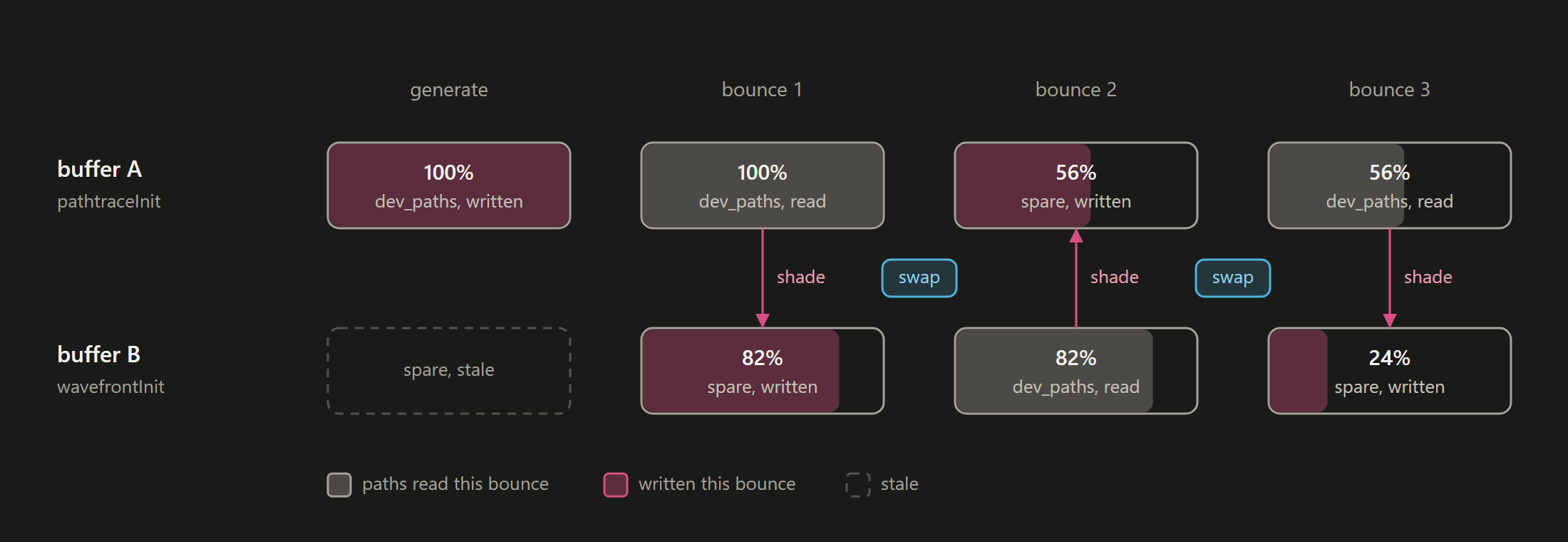
Each bounce is one OptiX launch and one CUDA kernel. The launch traces the live paths to their closest hit and, in the same launch, the shadow rays the previous bounce queued, which saves a launch per bounce. shadeMaterial then adds emitted light weighted by MIS, queues a shadow ray toward a picked light, runs Russian roulette, samples the next direction, and writes the surviving paths straight into the next bounce’s buffer with warp-aggregated atomics (stream compaction). The dashed box is the material sort (--sort), off by default since it slows most scenes down.
Rendering features
Meshes: glTF loading
glTF and glb files load through tinygltf (v2.9.7), either as the whole scene or as a "TYPE":"mesh" object in a scene JSON. Normal-mapped meshes without tangents get them from MikkTSpace. Textures are CUDA texture objects that decode sRGB in hardware; a texture that is missing renders magenta in the base color slot, so a broken asset shows in the render.
OptiX builds one triangle GAS per glTF primitive and one IAS over the instances. --no-optix falls back to the naive kernel, which tests every triangle and renders without NEE.
Naive loop vs OptiX by triangle count
1024x1024, ms per sample, median of 3 runs.
| scene | triangles | depth | naive | OptiX |
|---|---|---|---|---|
| cornell (spheres and cubes, no mesh) | 0 | 8 | 8.41 | 8.63 |
| cornell-box (research scene) | 36 | 66 | 11.56 | 11.43 |
| cornell_helmet | 15,452 | 8 | 320 | 8.42 |
| transmission_roughness | 77,792 | 12 | 1,511 | 7.37 |
| dragon_attenuation | 134,995 | 16 | 3,146 | 7.52 |
| sponza | 262,267 | 8 | 5,553 | 10.20 |
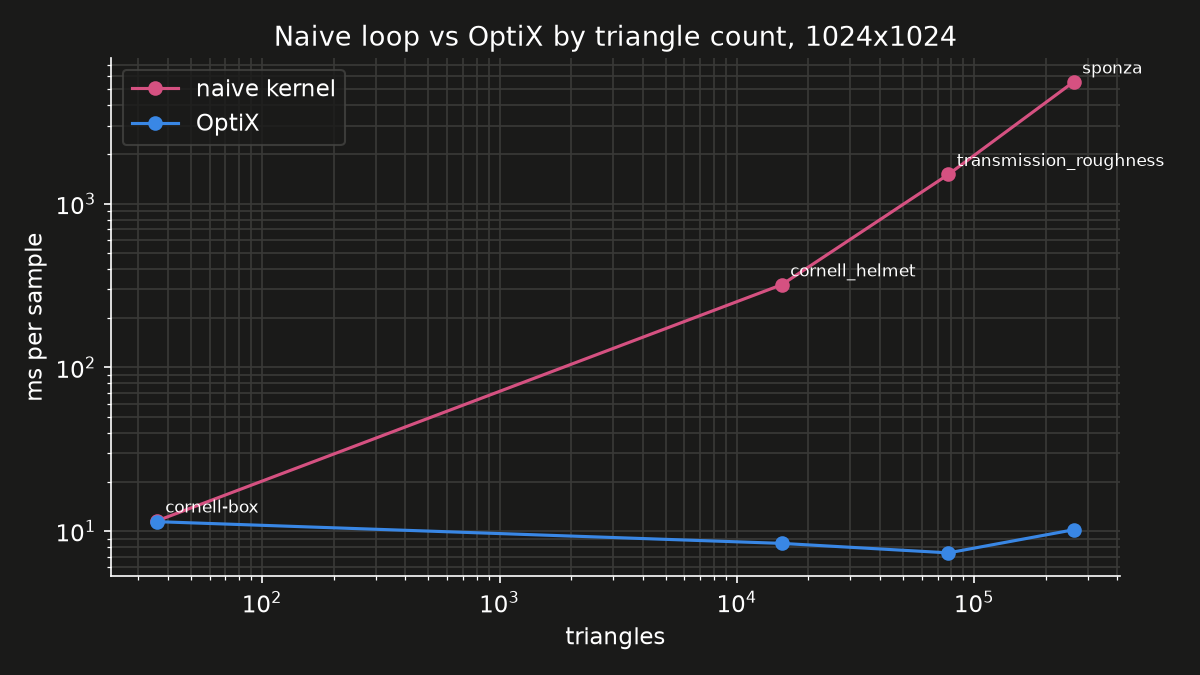
The naive kernel’s time grows linearly with the triangle count, about 20 ms per sample per thousand triangles, because every path tests every triangle at every bounce. OptiX stays within 15% of the Cornell frame time up to Sponza, and takes 12.7 ms on Intel Sponza (5.7 M triangles).
Materials: glTF metallic-roughness
Materials in this renderer take glTF 2.0’s metallic-roughness parameters and are shaded with the reference BRDF from Appendix B of the spec, extended to a BSDF by KHR_materials_transmission, volume, ior, specular, clearcoat and emissive_strength. Normal maps, alpha masks and alpha blending (as stochastic coverage) are supported. I chose to treat transmission as a solid boundary rather than glTF’s thin-walled default, since it better fits Blender’s export without the KHR_materials_volume extension.
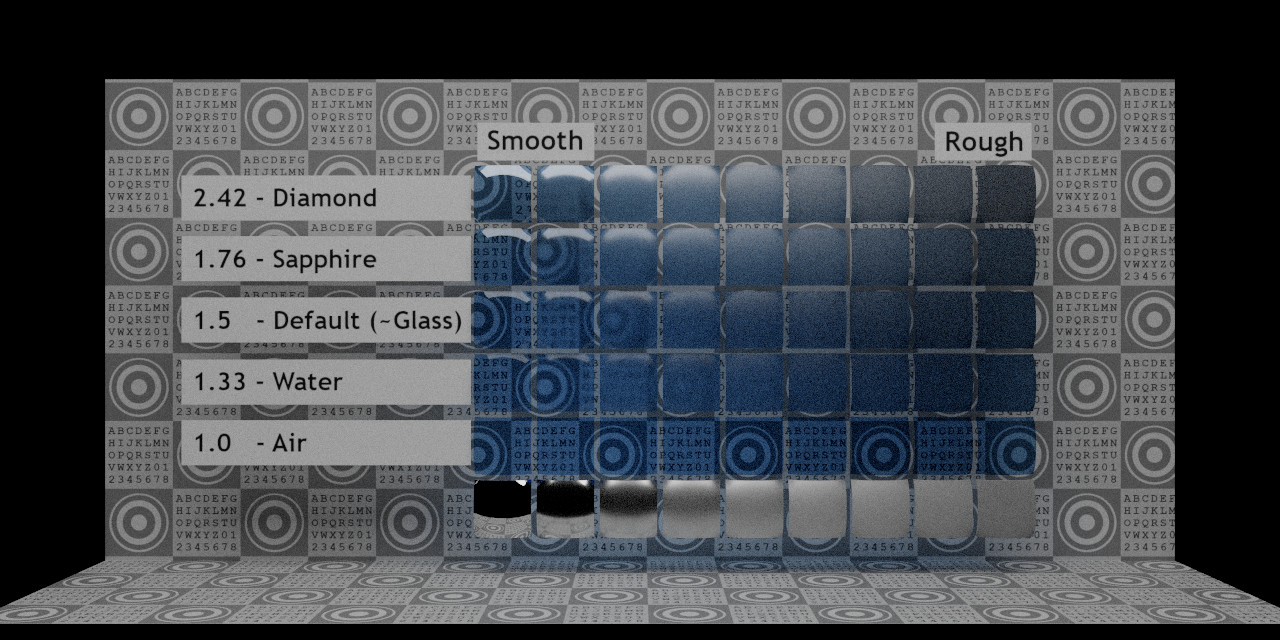
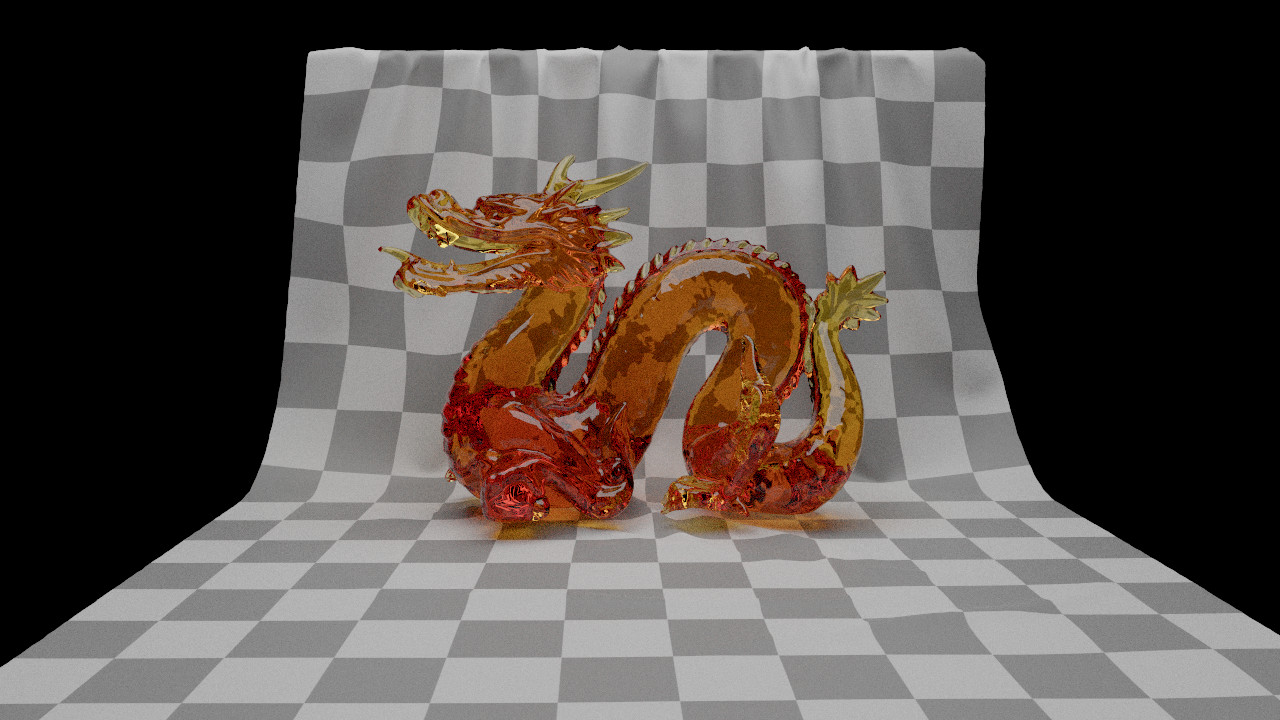
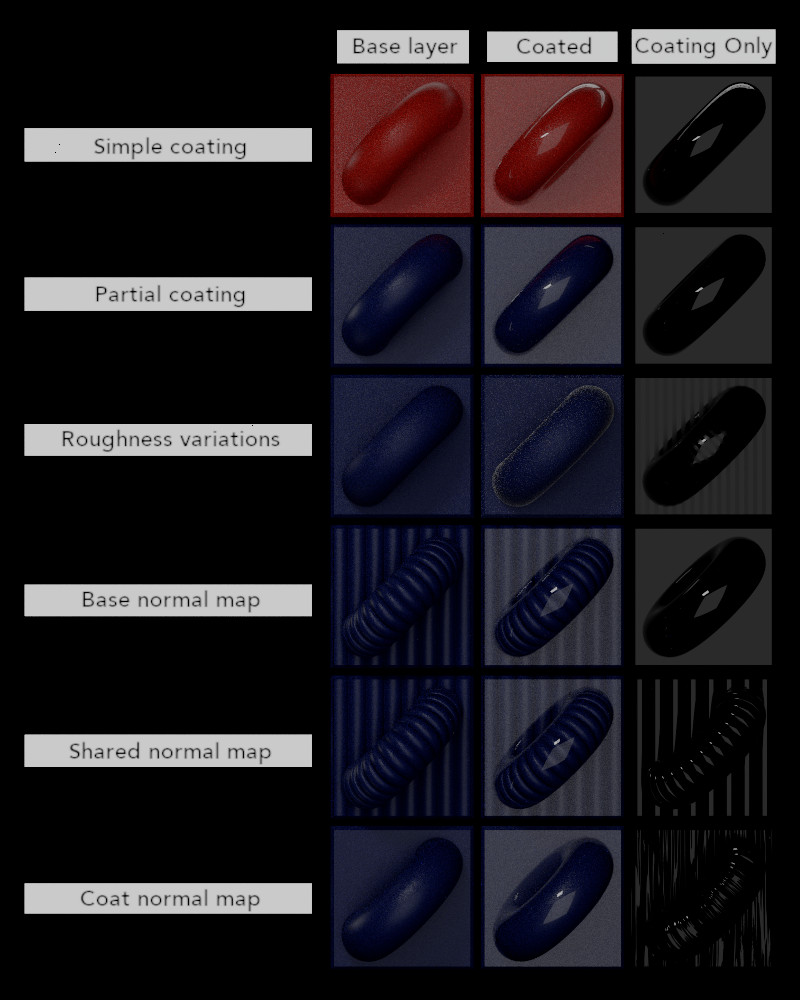
The three Khronos material tests ship without lights, so I added a light panel to the scene files. Rendered at 1024 spp, AgX.
| TransmissionRoughnessTest, 1280x640 | DragonAttenuation, 1280x720 |
|---|---|
 |  |
| ClearCoatTest, 800x1000 | DamagedHelmet, 800x800 |
 |  |
- TransmissionRoughnessTest: ior from 1.0 (top) to 2.42, roughness growing to the right. The ior 1.0 row stays sharp, since nothing bends a ray there.
- DragonAttenuation: one absorption color and distance; the thin tail comes out a fainter yellow and the thick body a deep orange.
- ClearCoatTest: the base layer’s broad highlight (left), the coat’s sharp one (right), and both (middle).
- DamagedHelmet: normal, metallic-roughness and emissive maps.
NEE and MIS
Every hit except a path’s last picks a point on a light and queues a shadow ray toward it. Multiple importance sampling weighs that light sample against BSDF-sampled rays that hit the same emitter, with the power heuristic (Veach 1997). Lights are picked in proportion to their power: emissive triangles, point, spot and directional lights from KHR_lights_punctual, and the environment map. With enough samples NEE + MIS and BSDF sampling alone converge to the same mean, within 0.1% on eight test scenes. --no-nee and a checkbox in the viewport panel turn it off.
Veach MIS, 1024x1024, 64 spp, AgX, OptiX.
| BSDF sampling only | NEE + MIS |
|---|---|
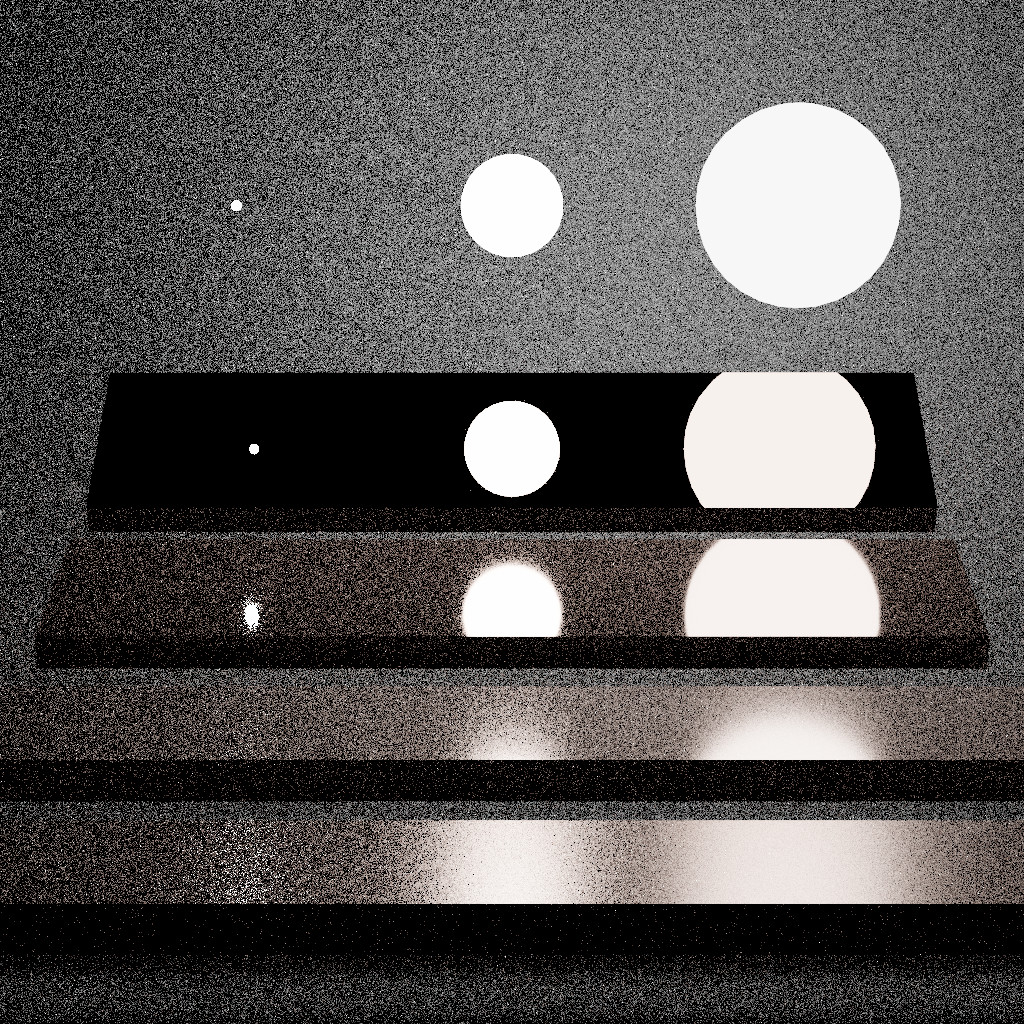 | 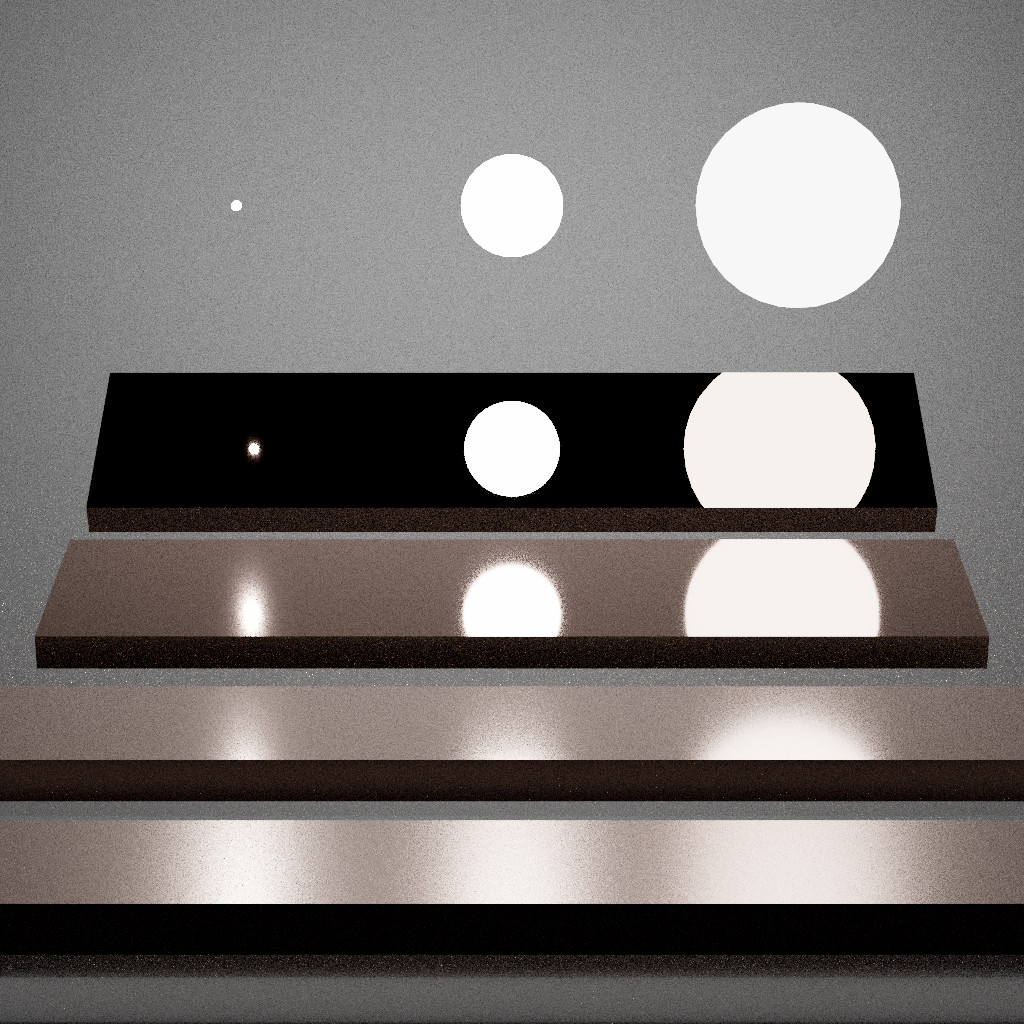 |
- Noise: the RMSE against a 4096 spp render drops from 62.8 to 9.1 (of 255), 48x less variance.
- Frame time: 2.34 ms/spp with NEE against 1.46 without.
Emissive textures in the light power
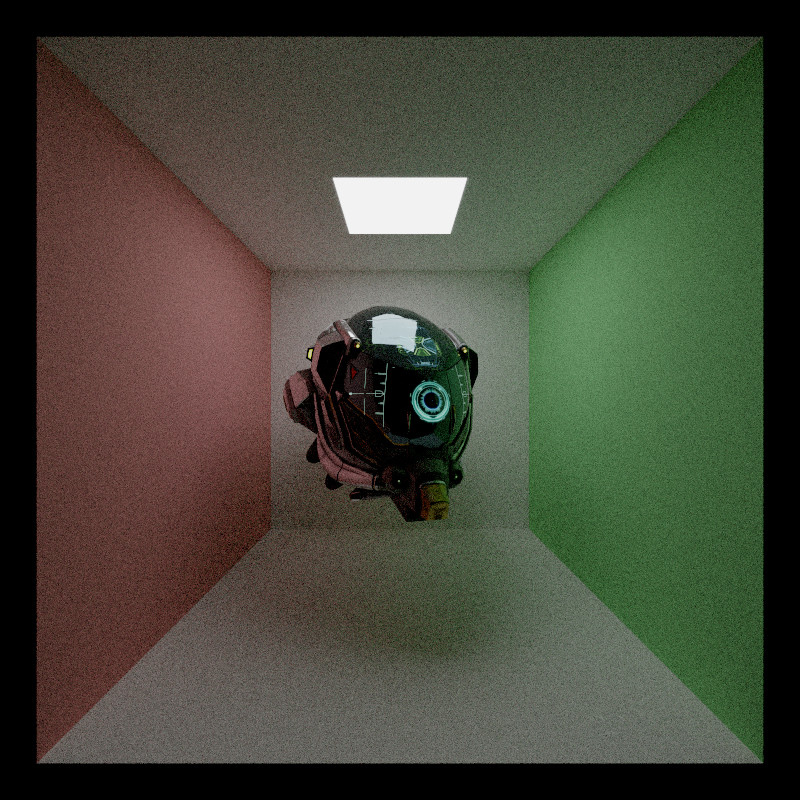
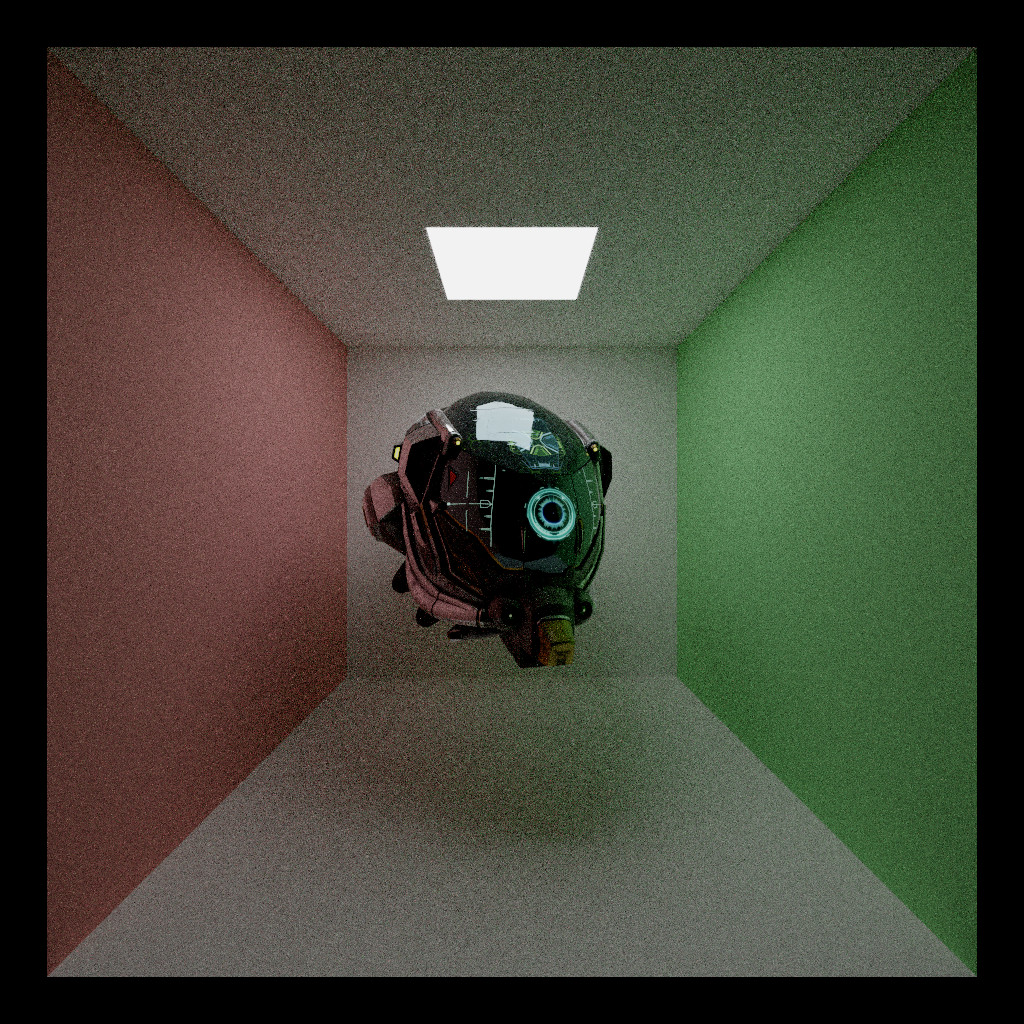
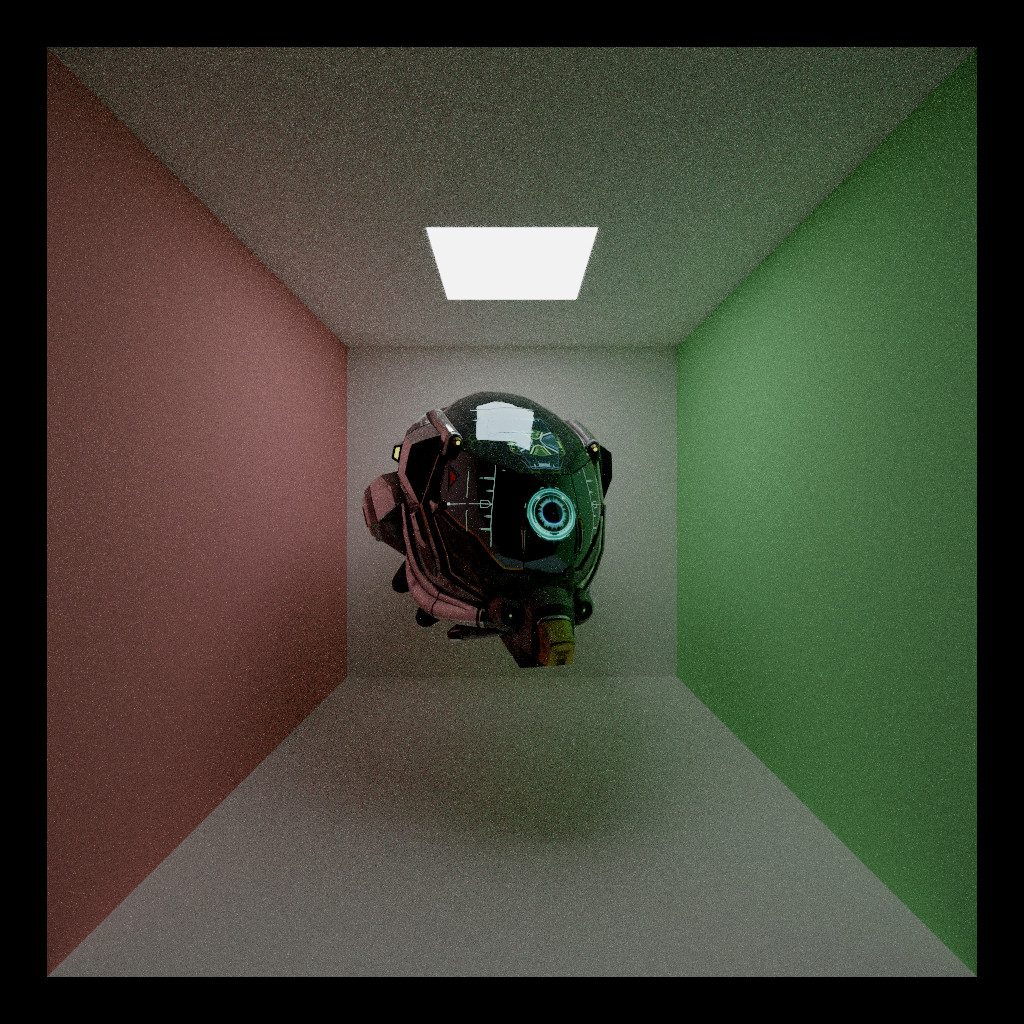
An emissive triangle’s pick weight is its emission factor times its emissive texture’s average (how PBRT-v4 weighs an image area light). DamagedHelmet is a really good example model with an emission texture, as it has many triangles with emission factor 1, but most of the emission texture is black. Before accounting for the texture’s average, the emissive triangles drew 63% of the light picks, and nearly all of them returned nothing. With the texture’s average they now draw 0.3%.
cornell_helmet, 1024x1024, 64 spp, AgX. Bottom row: the floor in front of the helmet at 2x.
| Before: emission factor only | After: factor x texture average |
|---|---|
 |  |
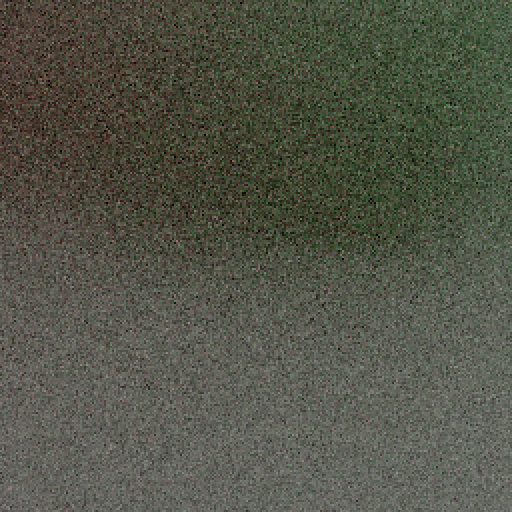 | 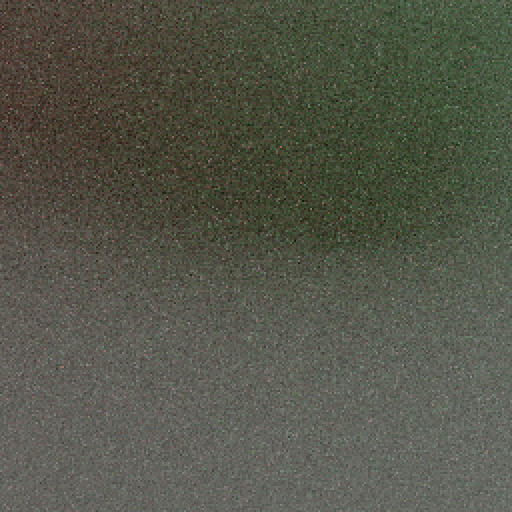 |
- Noise: RMSE against 4096 spp drops from 12.9 to 9.2 (of 255), about what twice the samples would give.
- Frame time: 3.0 against 2.9 ms/spp.
Light linking
Light linking allows a light to illuminate only the objects in a receiver collection. Stardust is the scene that relies on it. A light sample is dropped when the receiver is not linked to the picked light, and so is the emission a BSDF ray finds on an emitter its surface is not linked to, so the MIS weights still add up to 1. The light picks use one table per distinct receiver mask in the scene, so a surface only picks lights that can reach it (why).
Environment map sampling
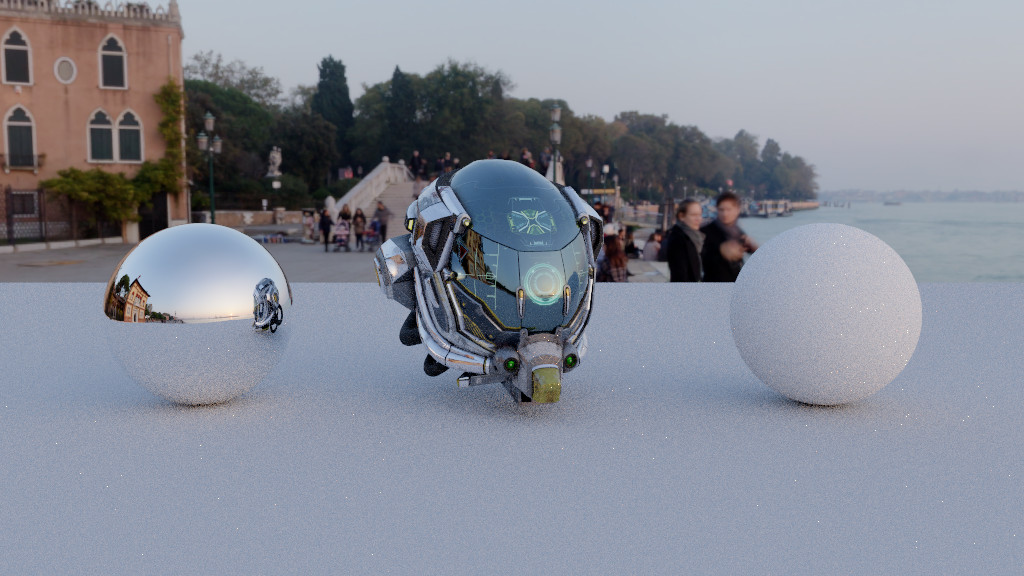
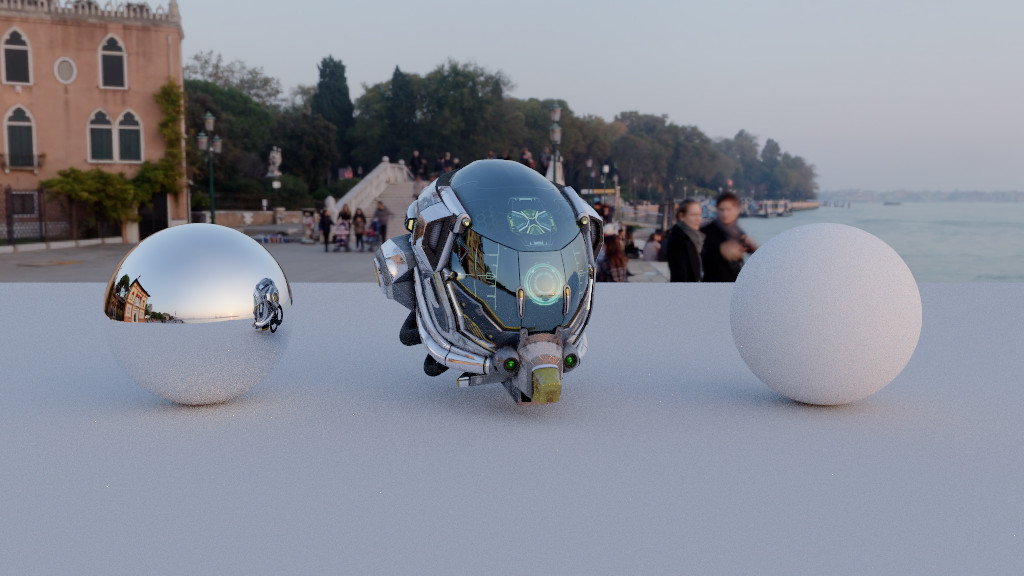
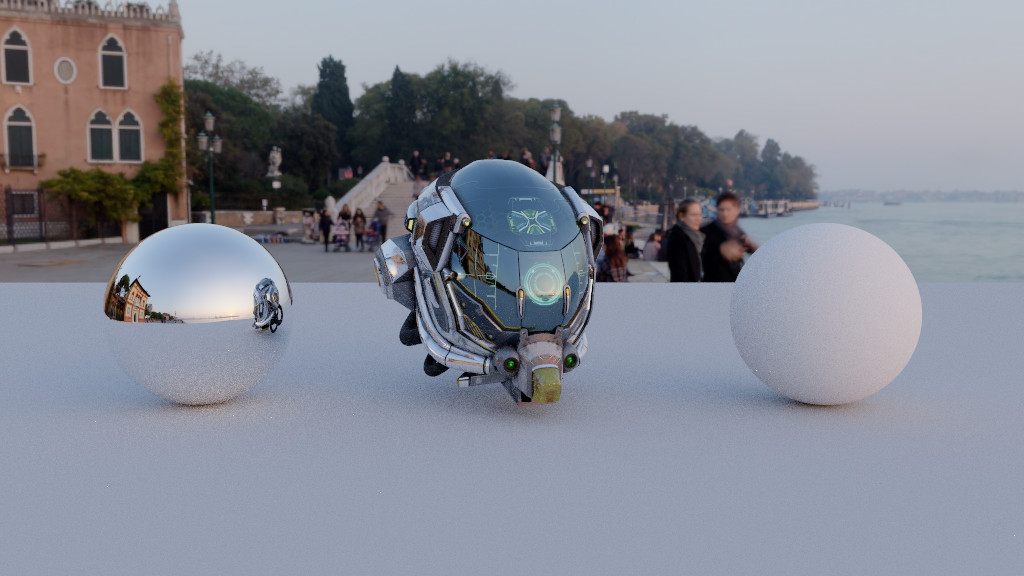
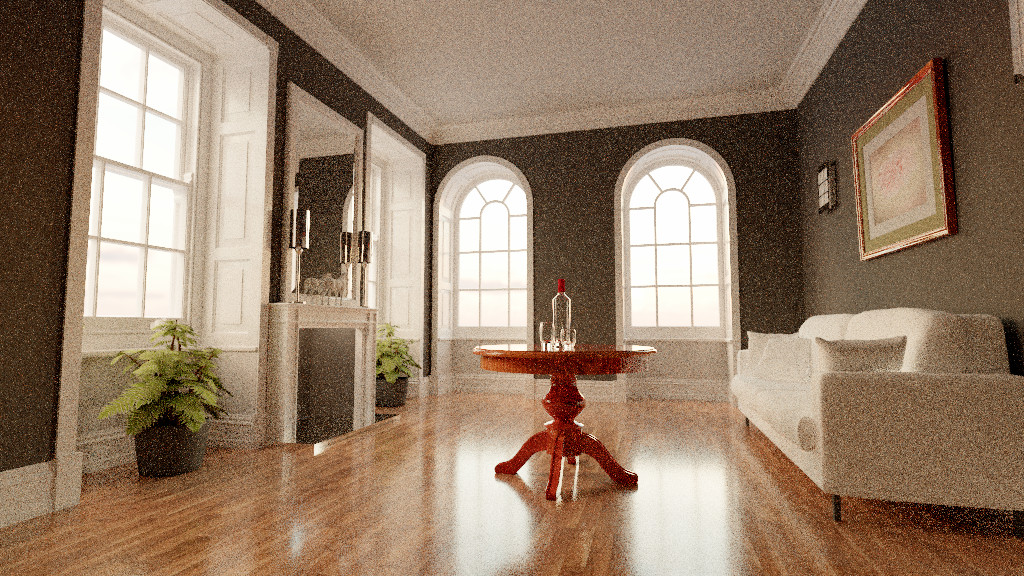
With the environment found by BSDF sampling alone, a diffuse surface under a sunset HDRI hits the sun by luck, which is the grain in the left column below. The environment is one of the lights NEE picks, drawn from a 2D table over the map’s luminance and weighed against BSDF sampling with MIS. MIS compensation (Karlík et al. 2019) subtracts the map’s average before the table is built, so the picks go to the sun and the bright patches, and BSDF sampling covers the even part of the sky.
hdri_helmet under venice_sunset_4k.hdr, 1024x576, 64 spp, AgX. Bottom row: the floor in front of the diffuse sphere at 2x.
| Environment by BSDF sampling | Environment NEE + MIS | With MIS compensation |
|---|---|---|
 |  |  |
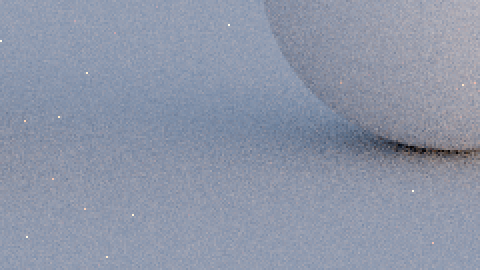 | 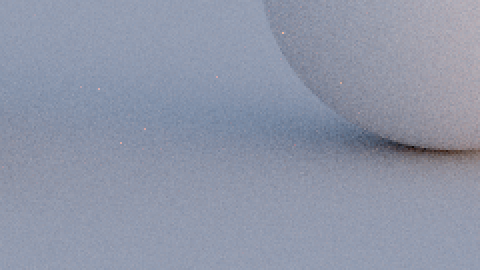 | 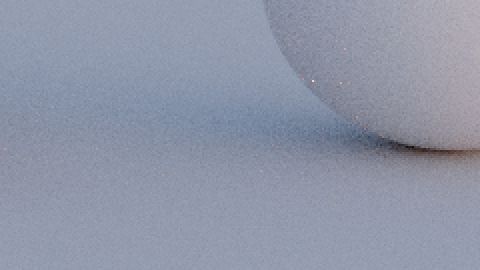 |
- Noise: RMSE against 4096 spp 4.34, 2.85 and 2.69 (of 255).
- Frame time: 1.11, 1.55 and 1.37 ms/spp.
- The specks left on the floor are the sun reflected by the chrome sphere, a caustic no light sample reaches.
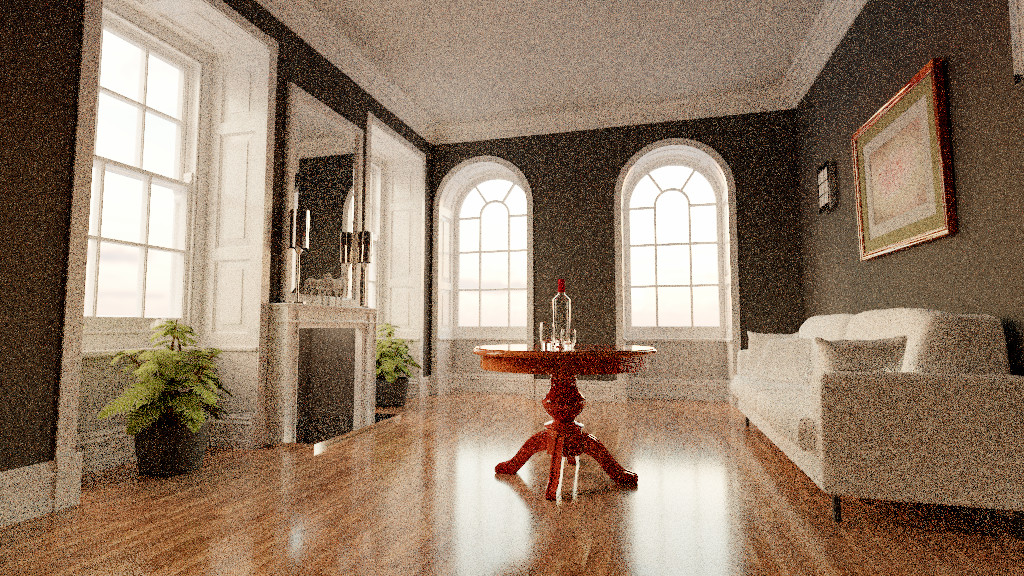
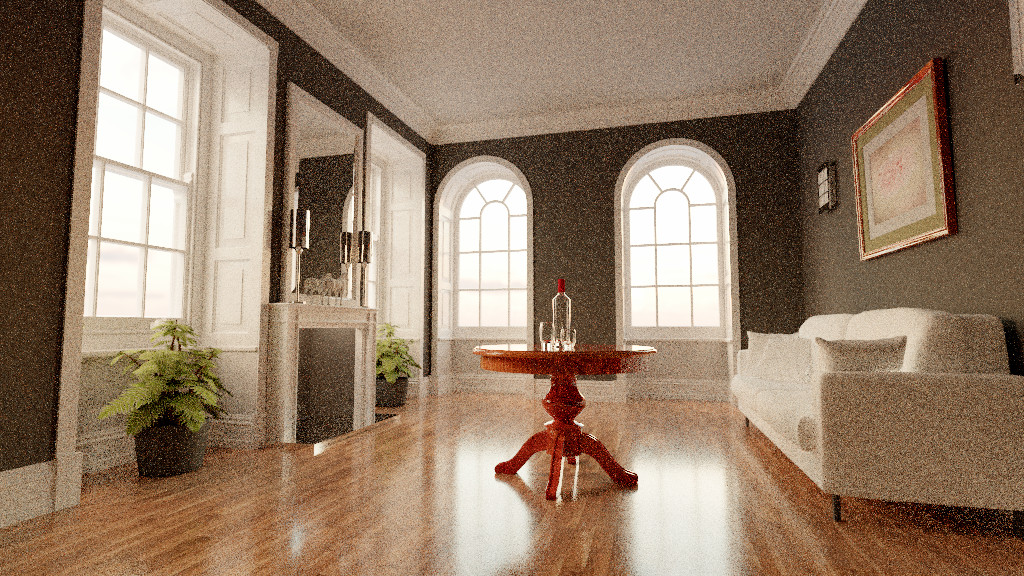
living-room, lit by its sky map alone, 1024x576, 256 spp, AgX. Bottom row: the ceiling and wall above the right windows at 2x.
| Environment by BSDF sampling | Environment NEE + MIS | With MIS compensation |
|---|---|---|
 |  |  |
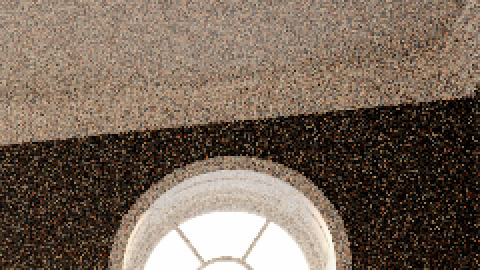 | 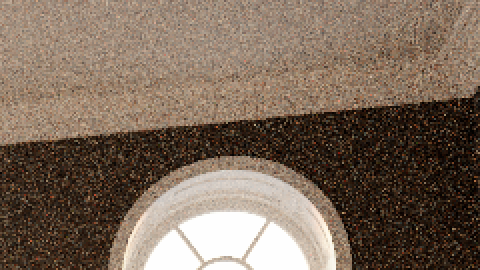 | 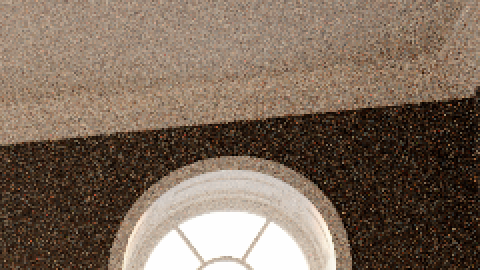 |
- Noise: RMSE against 2048 spp 24.5, 16.1 and 14.9.
- Frame time: 4.34, 7.42 and 6.85 ms/spp. Most environment shadow rays from inside a room end on a wall.
Antialiasing
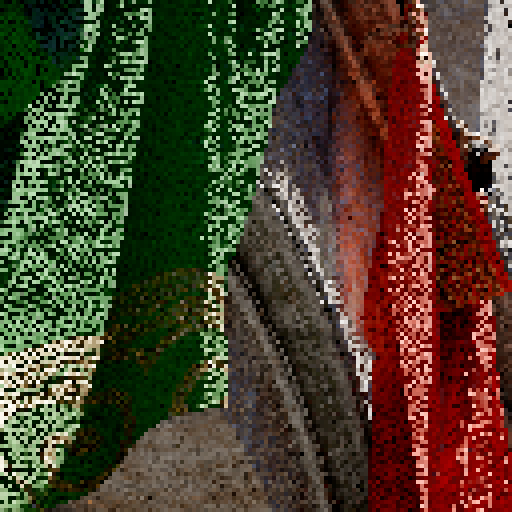
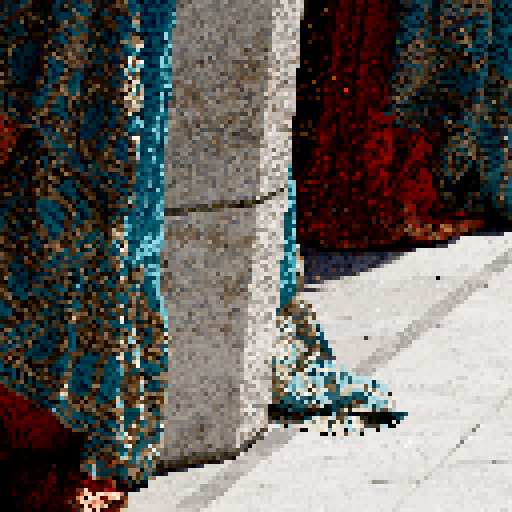
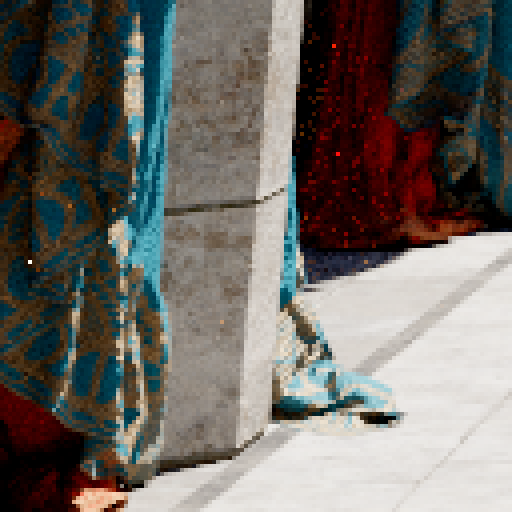
Every sample sends a pixel’s camera ray through a random point in the pixel instead of its center, so edges and textures average over the pixel as the samples accumulate. There are no mipmaps, so this jitter is also the only texture filtering: without it, fine texture detail aliases into speckle. --no-aa sends every ray through the pixel center for comparison. The jitter costs nothing measurable, 7.81 ms/spp either way.
Intel Sponza, 1024x1024, 1024 spp, AgX punchy. 128x128 crops at 4x:
| No antialiasing | Antialiasing |
|---|---|
 |  |
 |  |
Depth of field
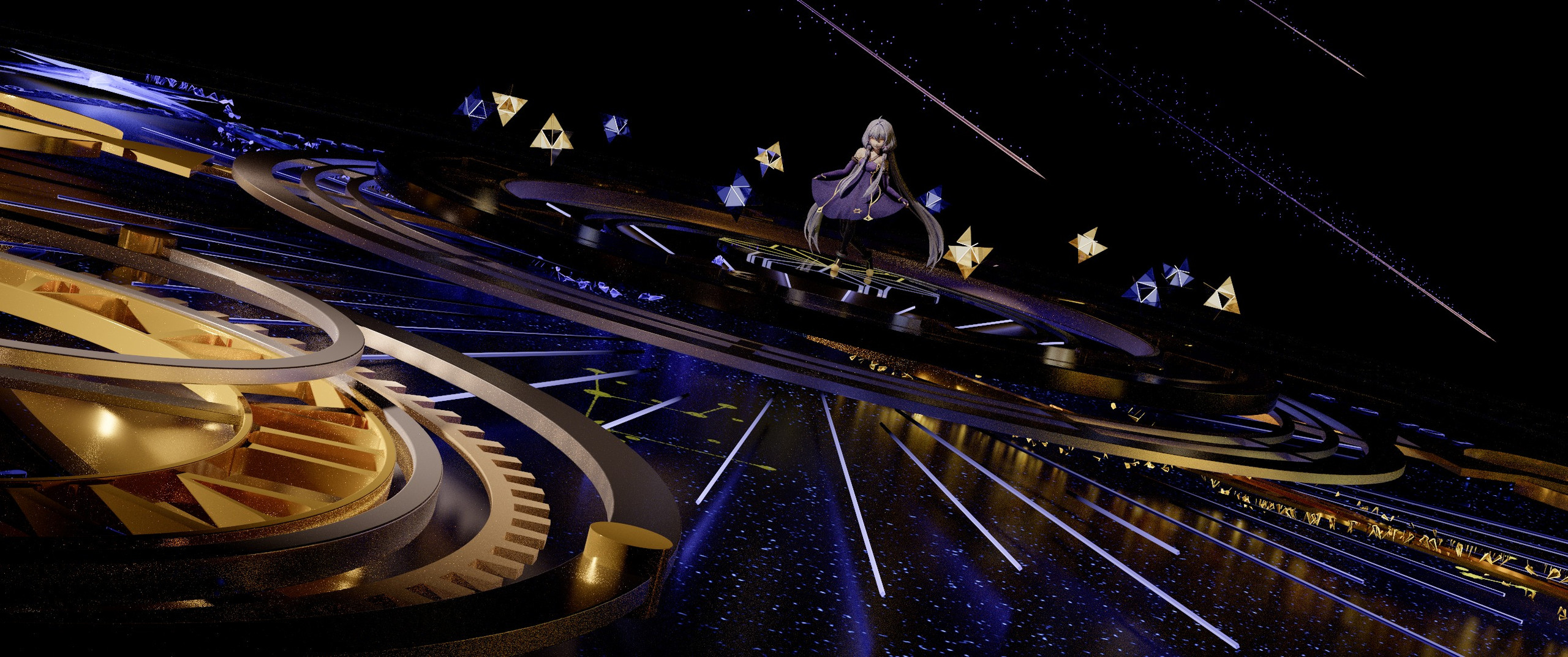
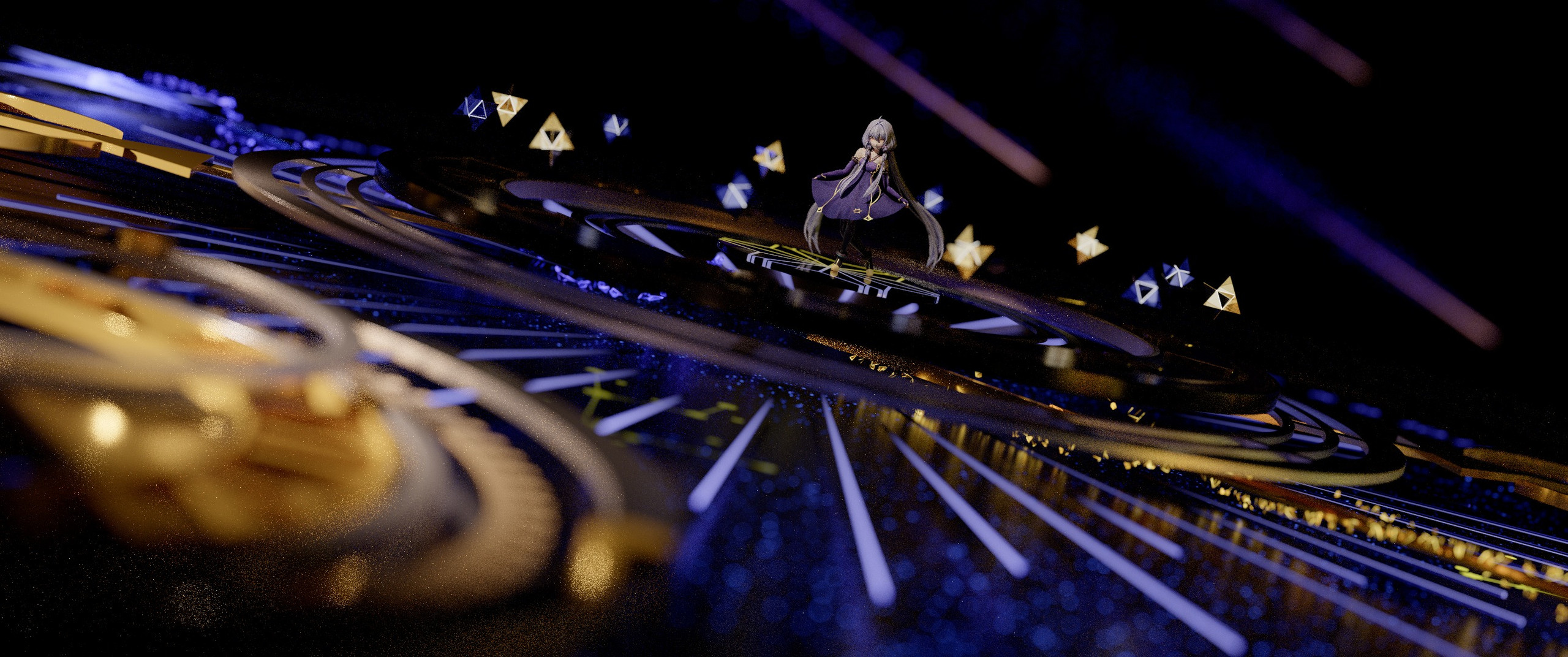
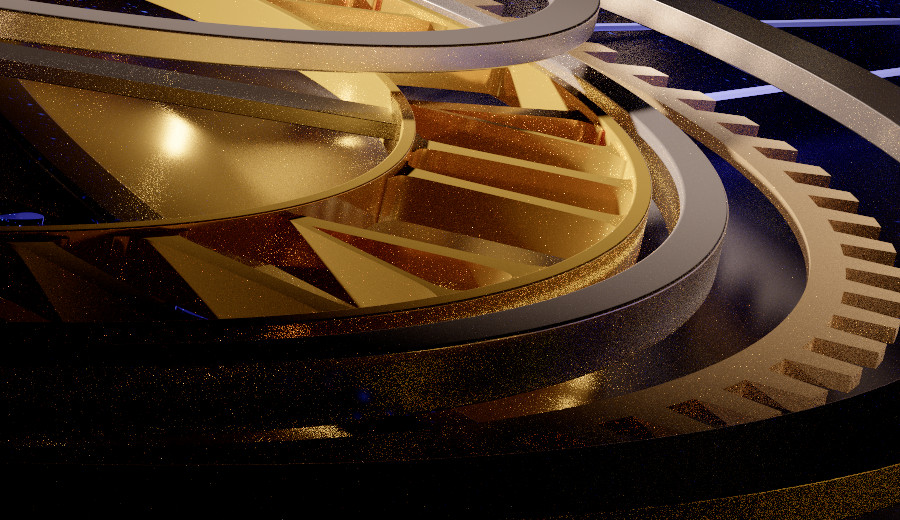
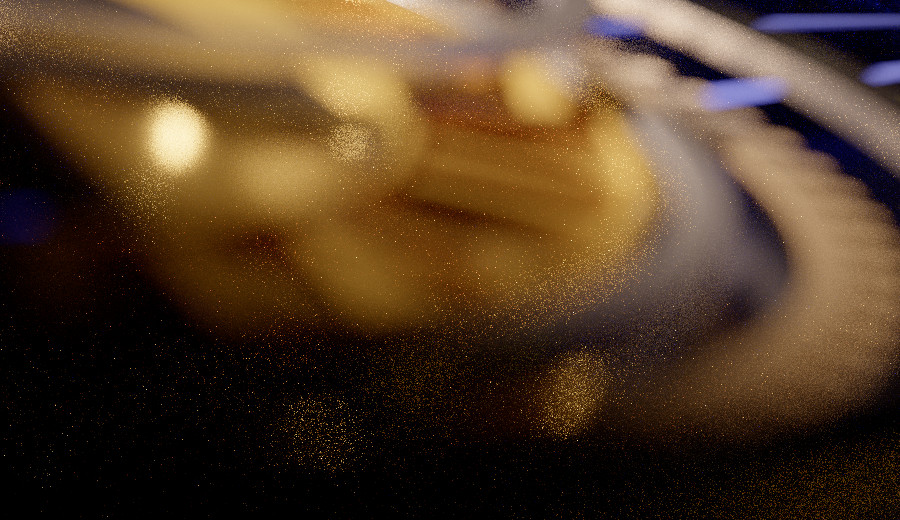
The thin lens camera starts each ray at a random point on a disk of radius APERTURE and aims it at the point where the pinhole ray crosses the plane at FOCUS, so that plane stays sharp and everything off it blurs with distance. Stardust’s aperture comes from the Blender camera’s focal length and f-stop (radius = focal length / 2N); the render below opens it to 0.15 from the cover’s 0.0625. --lens, --aperture and --focus override the scene file. The thin lens costs 8.36 against 8.06 ms/spp for the pinhole.
Stardust, 2580x1080, 2048 spp, DEPTH 12, AgX. Bottom row: the foreground gear at 1x.
| Pinhole | Thin lens, aperture 0.15 |
|---|---|
 |  |
 |  |
View transform
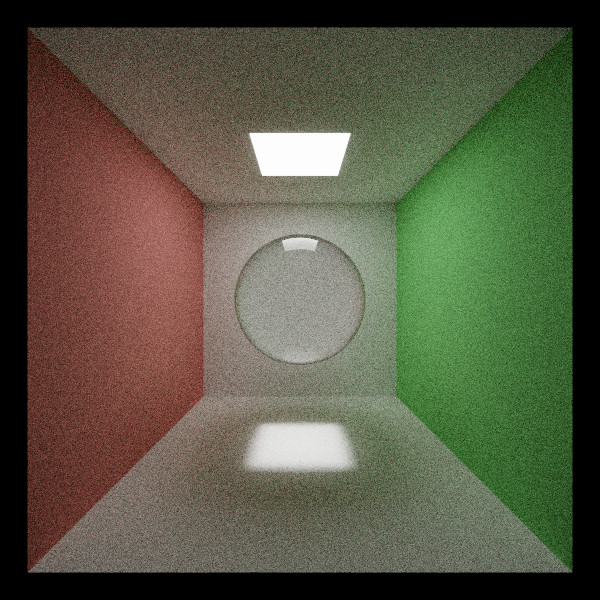
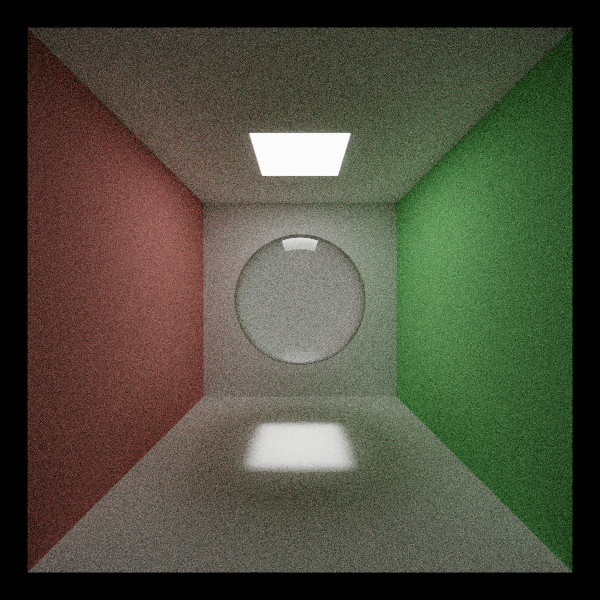
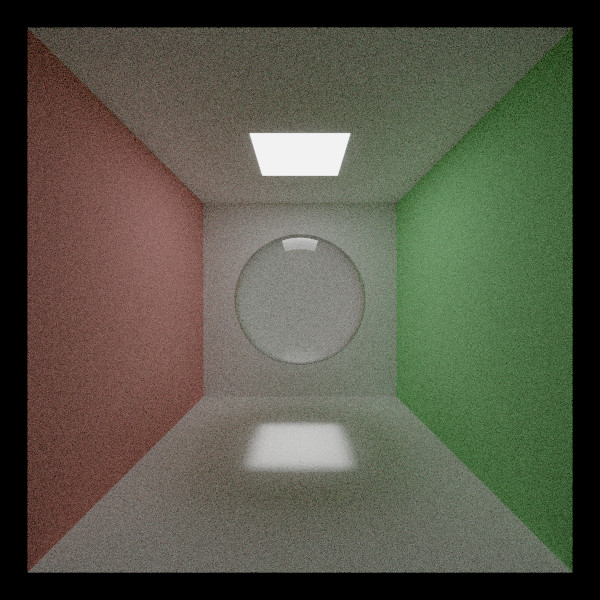
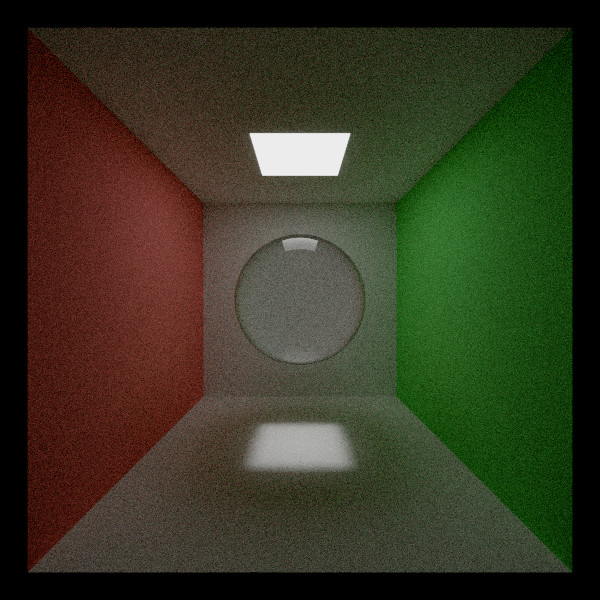
The accumulation buffer stays scene-linear, and the view transform runs at display and at save through the same function, so the viewport and the PNG agree. The default is AgX punchy, from Benjamin Wrensch’s Minimal AgX Implementation of Troy Sobotka’s AgX. ACES comes in Krzysztof Narkowicz’s fit and Stephen Hill’s (from MJP’s BakingLab).
Glass Cornell, 600x600, 1000 spp, exposure 1.0, DEPTH 8:
| ACES, Narkowicz fit | ACES, Hill fit (1/0.6) |
|---|---|
 |  |
| AgX | AgX punchy |
 |  |
Performance
Device link-time optimization
The base code builds with CUDA_SEPARABLE_COMPILATION ON, and without device link-time optimization a __device__ function from another file cannot be inlined. cuobjdump --dump-sass showed boxIntersectionTest, sphereIntersectionTest and scatterRay as real calls inside the kernels, with their arguments going through local memory.
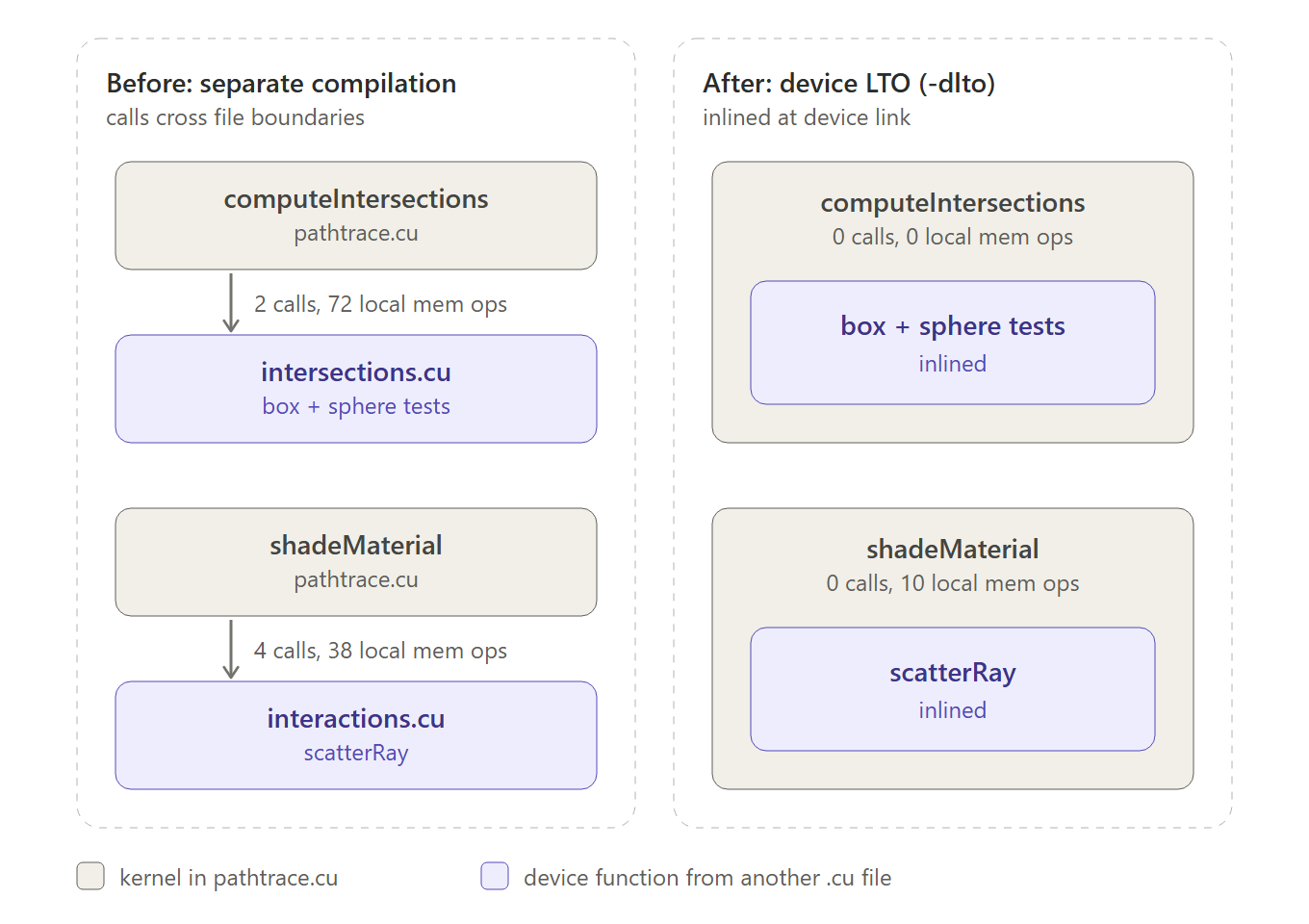
Release builds now add -dlto to the CUDA compile and device link options. The frame got 25 to 40% faster depending on resolution, but costs about 4 s of extra device link time per build.
Compaction and sort: thrust to CUB with device LTO
At first this renderer used thrust::stable_partition for compaction and thrust::sort_by_key for the material sort. With the sort on, a 400x400 sample took 13 ms, and timing each stage showed the majority of the frame time going to sorting.
| stage | generate | intersect | sort | shade | compact | gather |
|---|---|---|---|---|---|---|
| ms | 0.08 | 0.36 | 8.9 | 0.21 | 4.0 | 0.03 |
This is because every thrust call under thrust::device allocates scratch memory with cudaMalloc and frees it with cudaFree, which waits for all outstanding GPU work, and sort_by_key over a zip iterator copied every path through four radix passes. A caching allocator alone removed 60 to 70% of both stages. The CUB version removes the rest of the overhead by allocating its workspace once, drops ended paths instead of partitioning them to the back, and sorts (material key, path index) pairs over only the bits the material count needs before one gather.
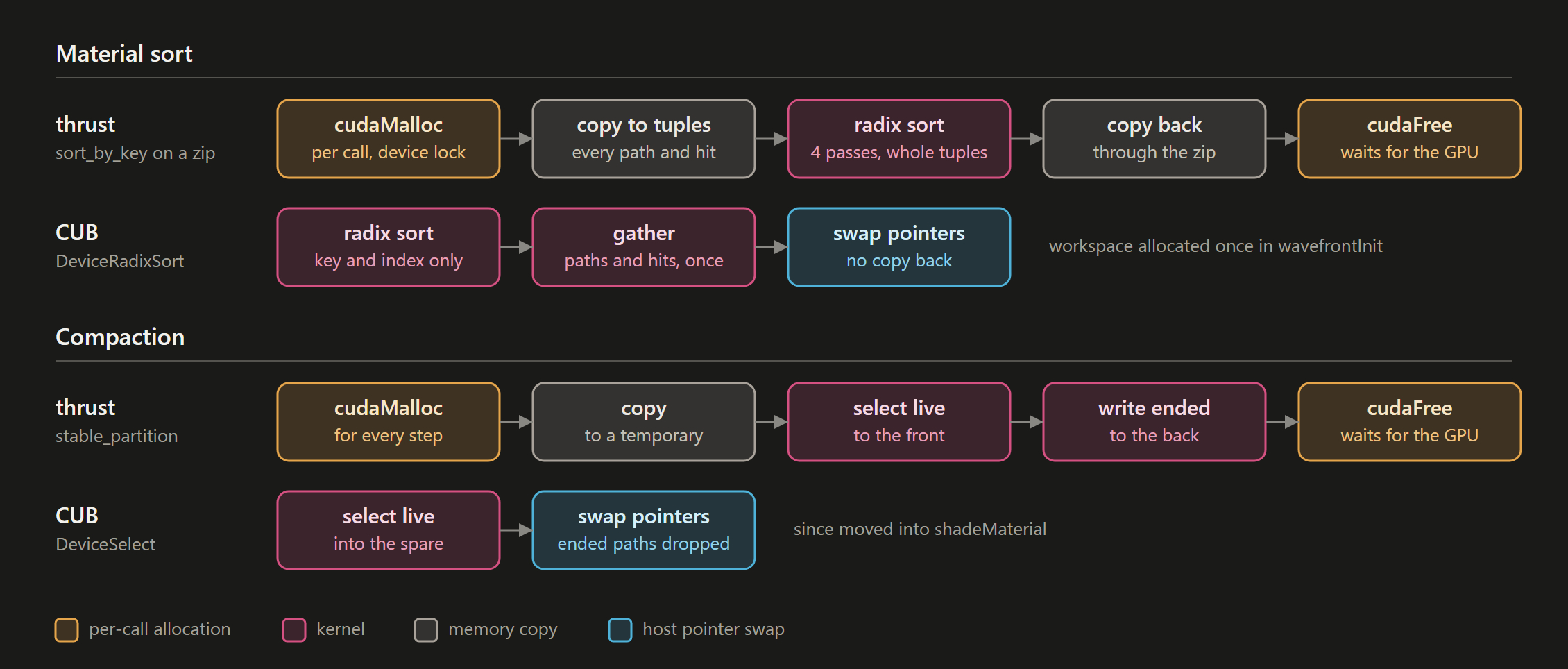
Buffer ownership over three bounces. Each bar is a whole buffer, filled to the share of paths alive.
Cornell, median of 5 runs, ms per sample.
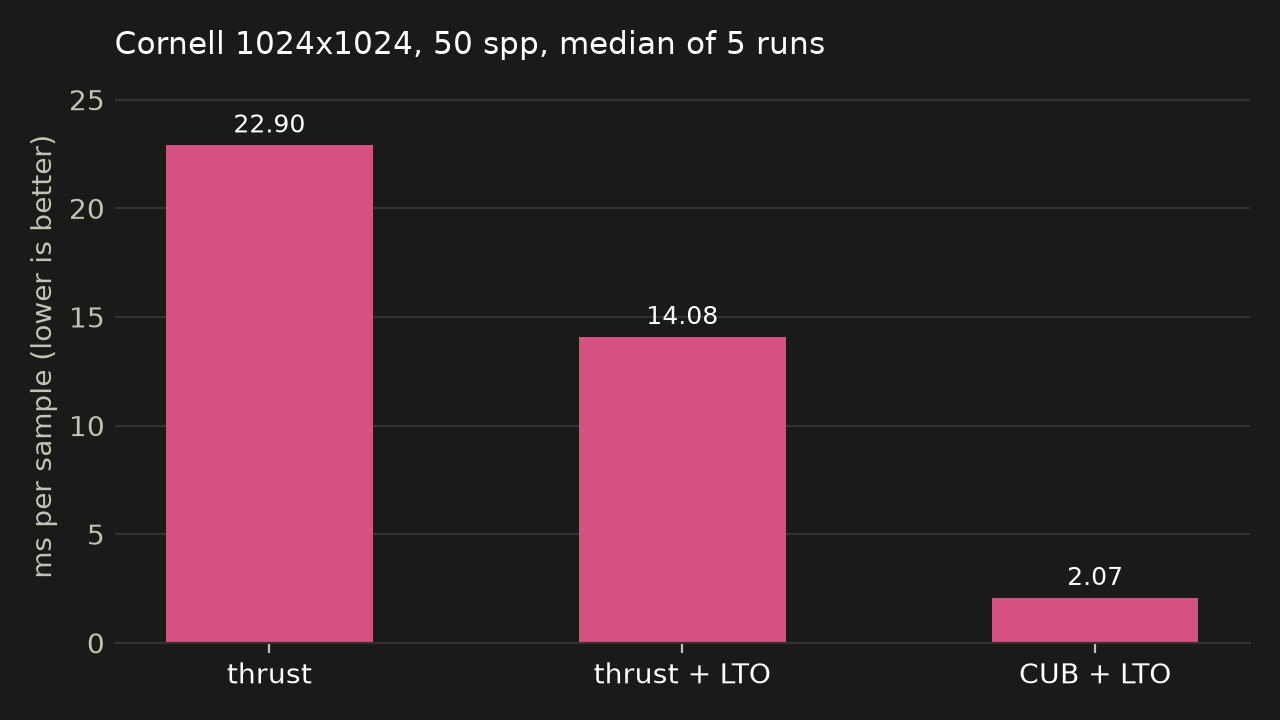
At 1024x1024 the frame went from 22.90 to 2.07 ms per sample, 11x. Device LTO is 1.6x of that on its own.
Compaction moved into the shade kernel
Motivation: In a Nsight Systems profile on Cornell at 1024x1024, the CUB compaction took 0.49 ms of a 2.59 ms sample (19%; 6% on Intel Sponza). It reads every path shadeMaterial has just written, writes the live ones a second time, and adds two launches per bounce.
How it works is warp-aggregated atomics. shadeMaterial writes the surviving paths straight into the spare buffer. The warp votes with __ballot_sync, lane 0 reserves room for the warp’s survivors with one atomicAdd, and each survivor writes to that base plus its rank among the survivors (__popc), so the stores stay coalesced.
1024x1024, 100 spp, median of 5 runs, ms per sample.
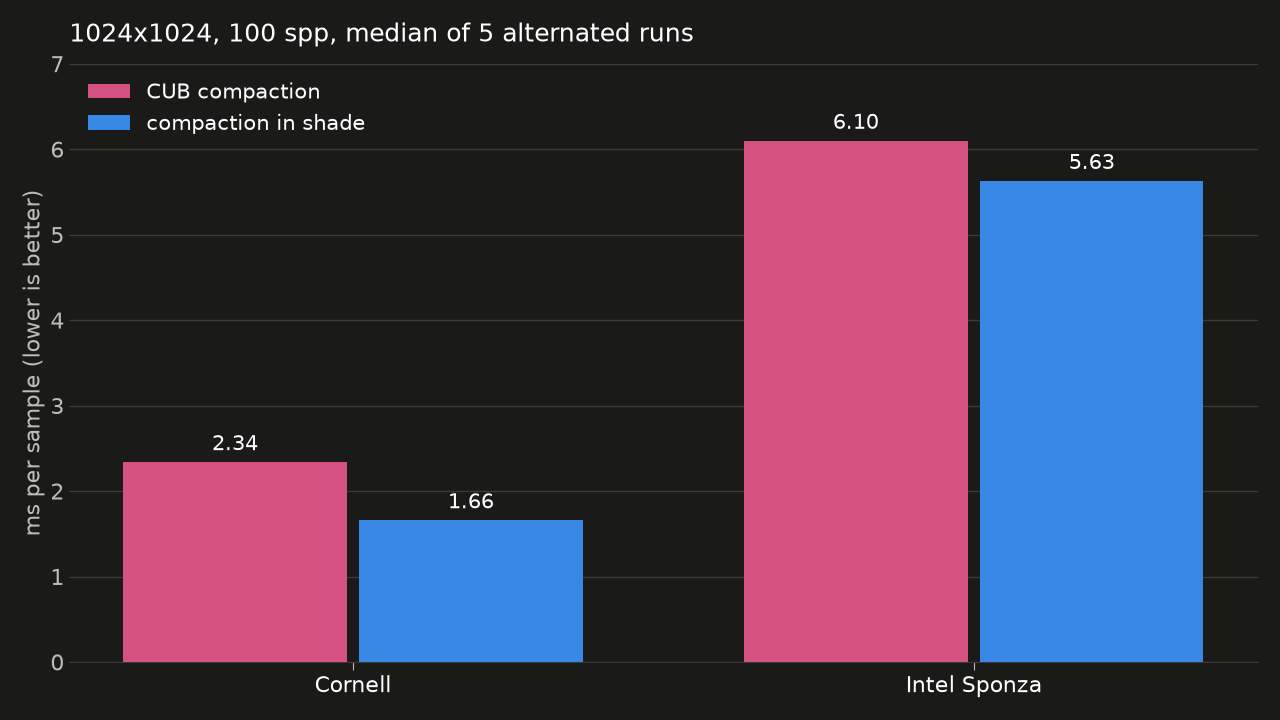
- Compaction kernels: gone, 0.49 ms.
shadeMaterial: 0.67 to 0.54 ms, since it writes only the survivors (18 to 50% of the paths had ended by bounces 1 to 3). By bytes alone that is about 0.05 ms; I have not looked into where the rest comes from.- Idle time: 0.10 ms less, from the launch gaps that went with the compaction kernels.
Keeping the survivor count on the GPU instead of reading it back each bounce gained only 0.07 ms on Cornell and 0.1 to 0.2 ms on Intel Sponza, at the cost of queuing whole samples ahead of the GPU and losing per-bounce error checks, so I left it out.
Paths alive per bounce
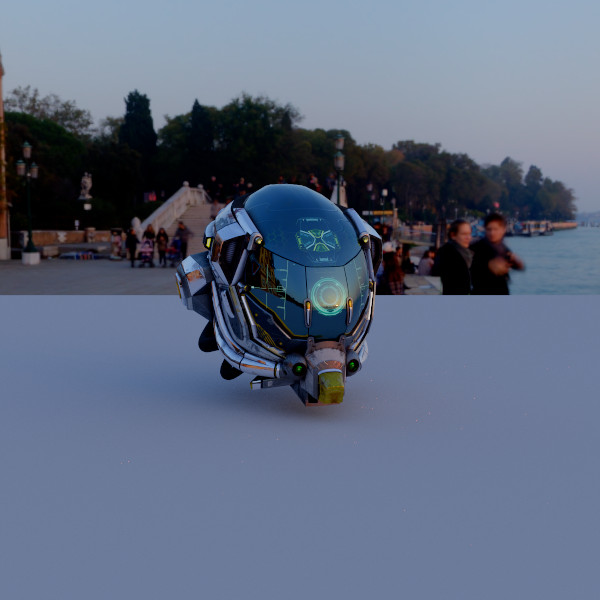
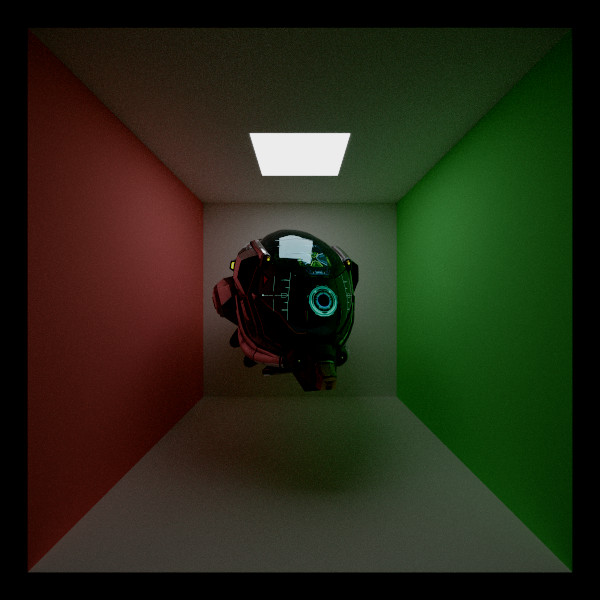
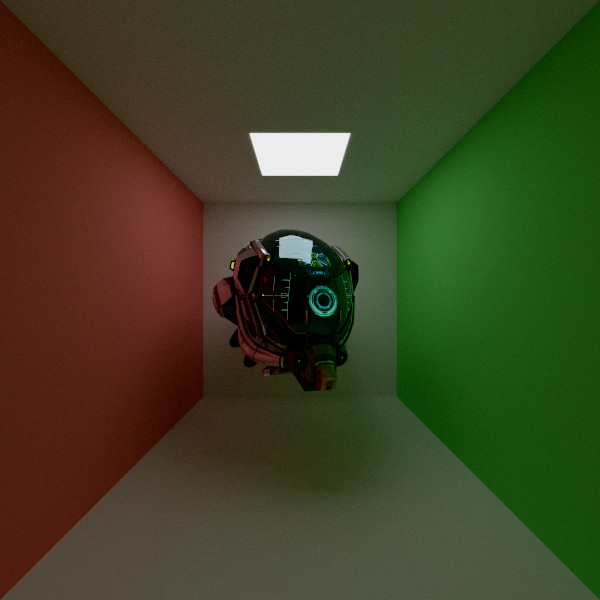
Three scenes with the same DamagedHelmet, from open to closed, at 1024x1024 and DEPTH 8: the helmet on a plane under an HDRI (helmet_plane.json), the stock Cornell box with its front open (cornell_helmet.json), and a closed box with a sixth wall behind the camera (cornell_closed.json), where a path ends only on the light, by Russian roulette or at DEPTH.
| Helmet on plane | Cornell box, front open | Closed Cornell box |
|---|---|---|
 |  |  |
Paths alive entering each bounce, from --timing:
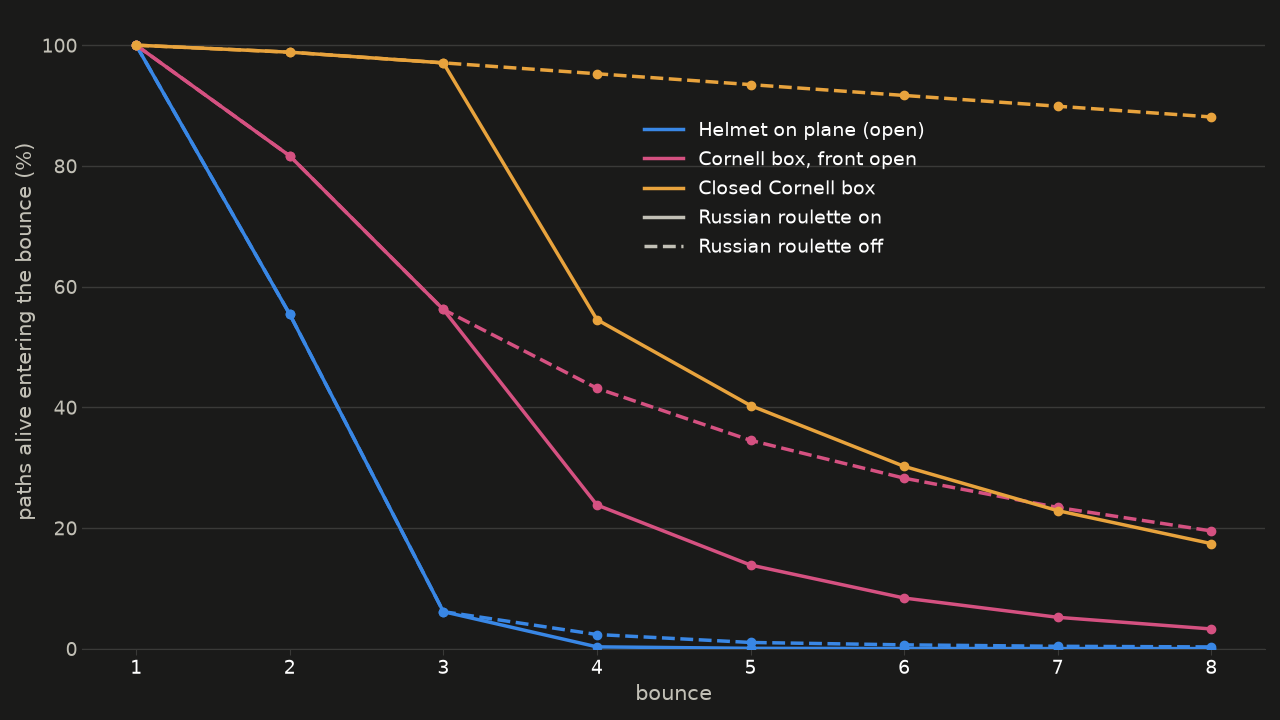
- Helmet on plane: 44.6% of the paths see the sky at the first bounce, and most rays off the plane go up to the sky too, so only 6.1% are left by bounce 3 and Russian roulette has almost nothing to kill.
- Cornell box, front open: without Russian roulette about a fifth of the paths end per bounce, out of the open front or on the light. With it, 58% of the rest end at bounce 3 and about 40% per bounce after.
- Closed Cornell box: only 1 to 2% end per bounce, and without Russian roulette 88% are still alive at bounce 8.
Open and closed scenes
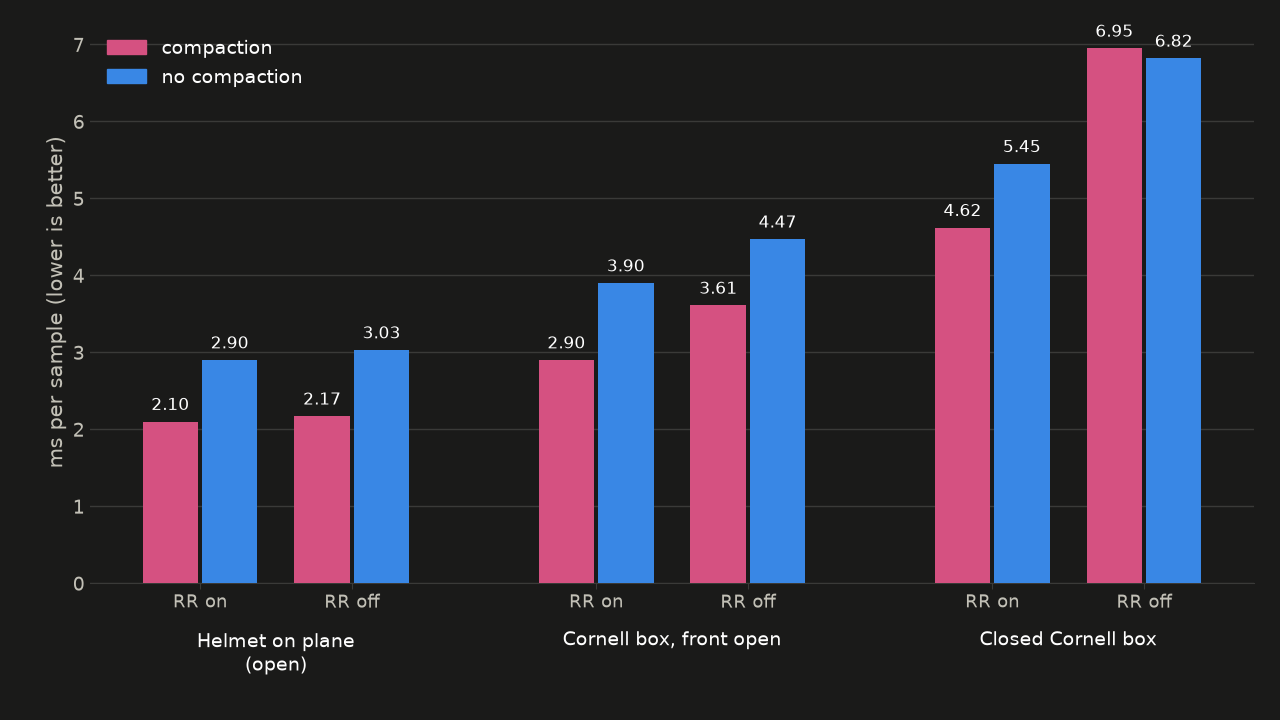
--no-compact turns compaction off: every bounce launches over all 1,048,576 paths, and the kernels return early on a path that ended. Both modes render the same image.
Headless, 1024x1024, 100 spp, median of 5 alternated runs, ms per sample:
Time per bounce with Russian roulette, median of 5 --timing runs:
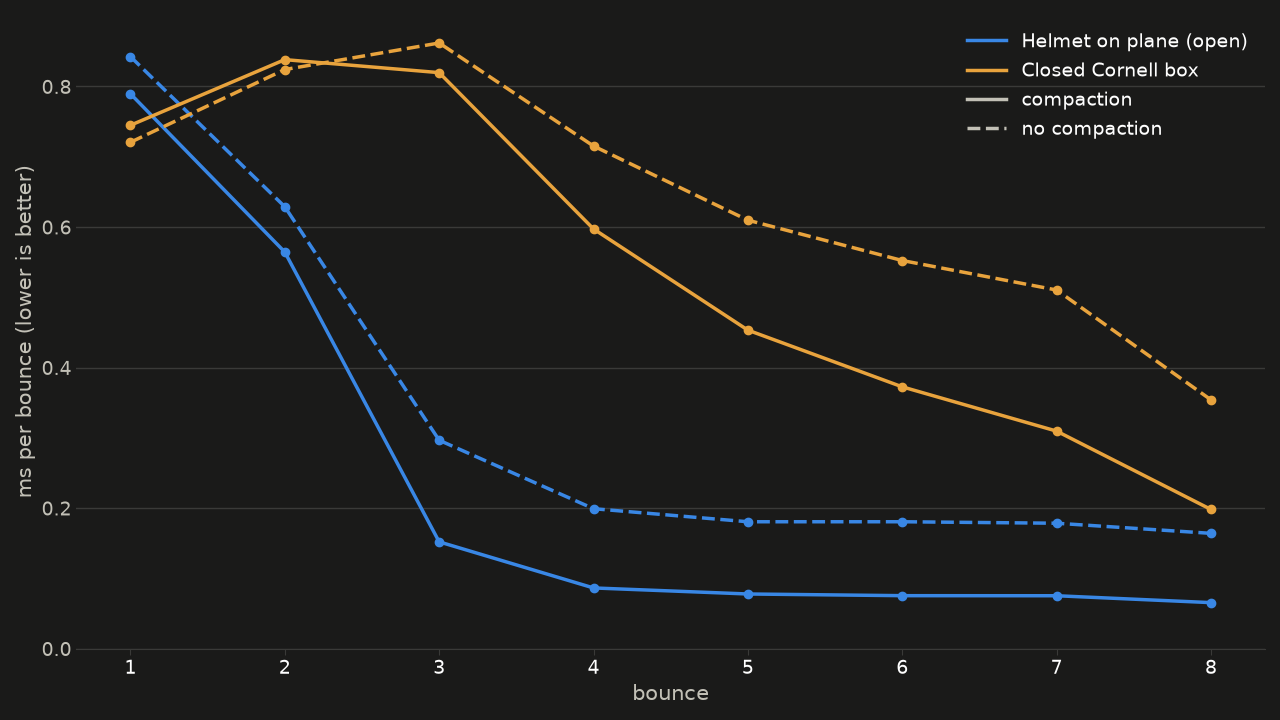
- Open scenes: compaction saves 28% on the helmet plane and 26% in the open Cornell box. Once most paths are gone, a compacted bounce costs about 0.08 ms (the launches and the count readback), against about 0.18 ms for a full-width launch whose threads load their path and return.
- Closed box: compaction saves 15%, only as much as Russian roulette removes. Without the roulette it is 2% slower, since it drops almost nothing and still pays for the warp vote and the atomic.
- Russian roulette: saves 34% in the closed box and 3% on the helmet plane, where few paths live long enough to roll.
- Bounce 2 costs more than bounce 1 in the closed box with nearly every path alive: camera rays leave in neighboring directions and diffuse bounce rays do not, so their traversal is less coherent.
Russian roulette
From the third bounce, a path survives with a probability equal to its throughput’s luminance (at most 0.95), and a survivor’s throughput is divided by that probability, which keeps the estimate unbiased. --no-rr turns it off.
Headless, median of 3 interleaved runs, ms per sample.
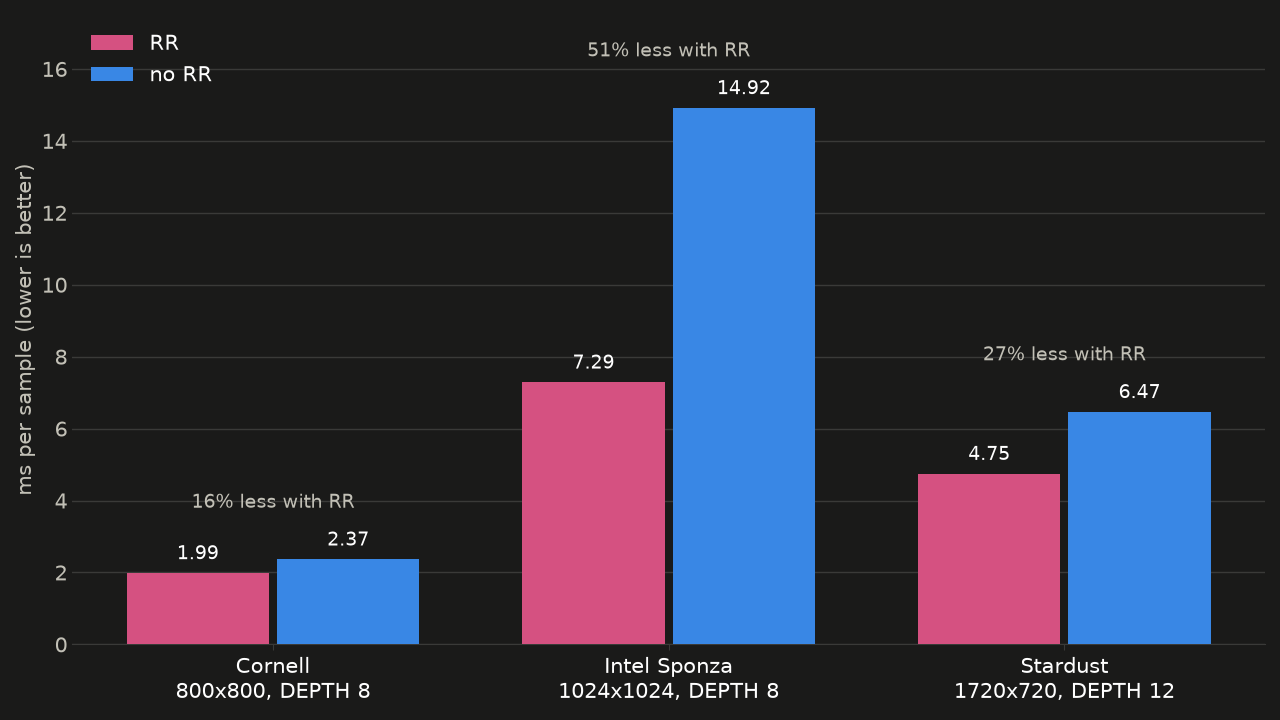
- Paths ended at the third bounce: 96% in Sponza with RR, against 17% without it. Two bounces off its dark stone leave a path a few percent of its throughput, so most paths lose the roll.
- Noise: at 512x512 and 256 spp, the RMSE against an 8192 spp render without RR is 11.12 against 10.81 (of 255) in Sponza, and 4.94 against 4.23 in Cornell. Per unit of time that makes RR about 1.6x as efficient in Sponza, but only about 0.85x in Cornell. My guess is that Cornell’s white walls leave the paths RR ends with much of their throughput, so the variance it adds outweighs the 16% it saves.
Material sort
--sort radix-sorts the paths by the material they hit and gathers them into that order before shading, so the threads of a shadeMaterial warp read the same material. It is off by default because it performs worse.
Headless, 1024x1024 (Stardust 1720x720), 100 spp, ms per sample by stage from one --timing run per bar:
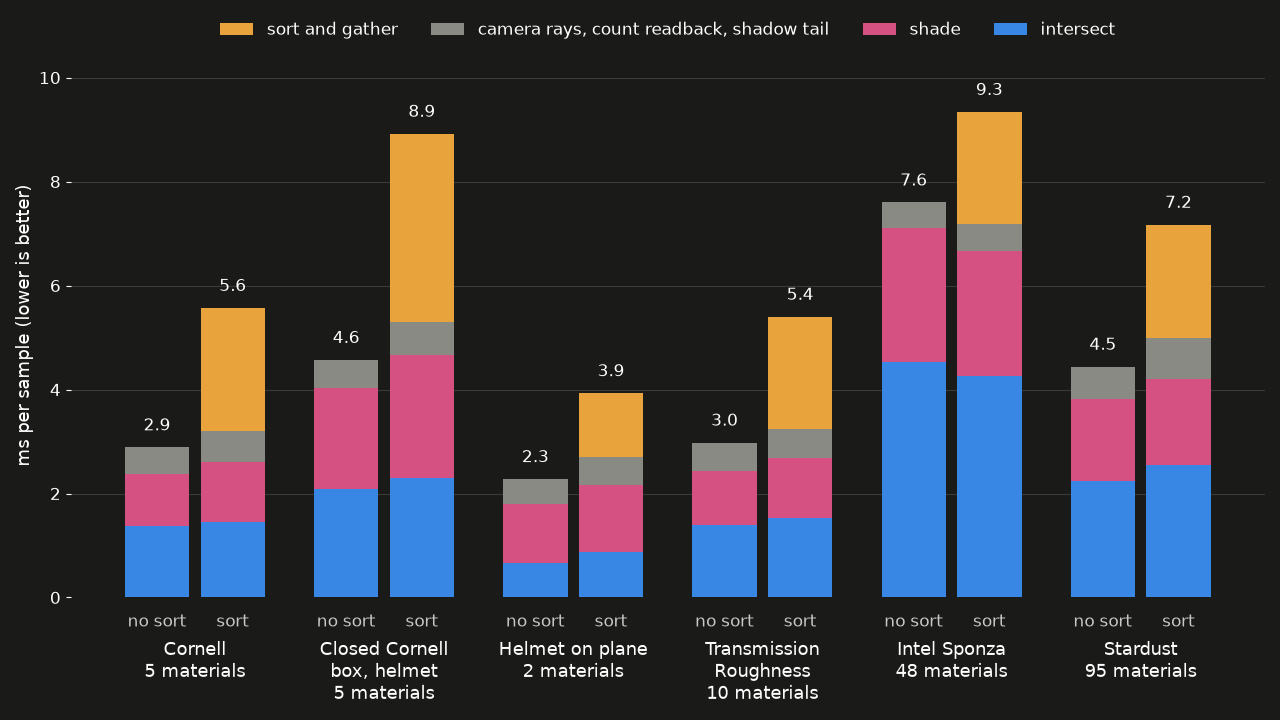
The sort makes every scene 1.2x (Sponza) to 1.9x (Cornell) slower, all of it in the sort stage. shadeMaterial itself changes by at most 0.45 ms, and only Sponza, with 48 materials, gets faster; the scenes with a handful of materials get slightly slower. Every material goes through the same scatterPbr, and the lobe a path samples is a random choice per path, sorted or not, so there is little divergence for the sort to remove, however many materials there are. My guess is that Sponza gains its bit because sorted warps fetch the same textures; I have not profiled it.
Why is my sort so slow???
Looking into the gatherByIndex kernel of the glm 0.9.6 build in Nsight Compute with warp stall sampling, the SASS shows that the compiler turns every pathsOut[i] = pathsIn[src] into 3 pairs of loads and stores, each store depending on its load.
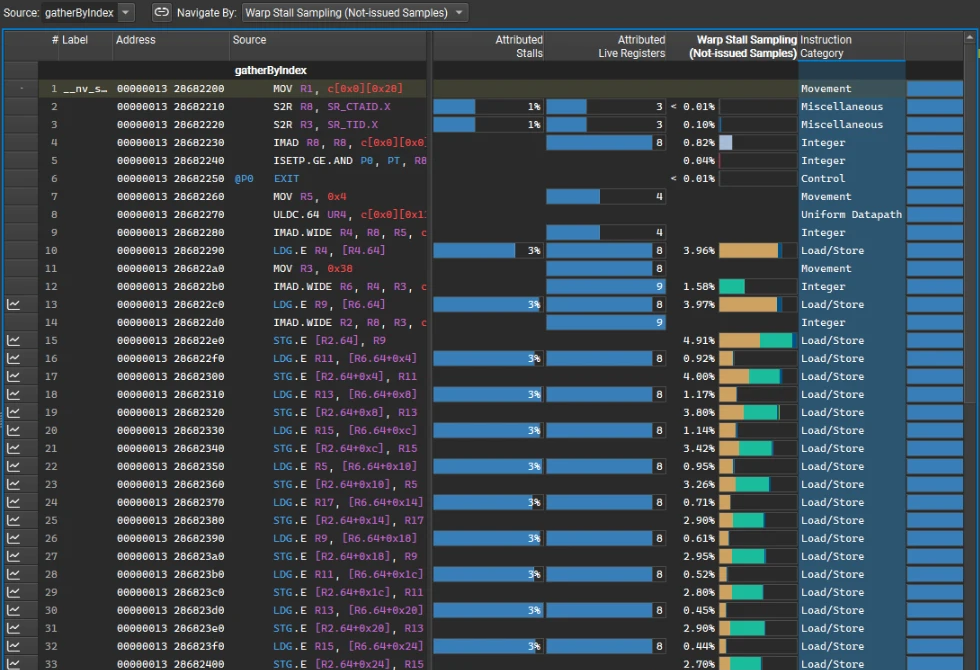
This is because the base code’s glm 0.9.6 writes the vectors’ operator= by hand, which makes every struct holding a glm::vec3 not trivially copyable, and the compiler cannot reorder the loads and stores because it doesn’t know whether the two PathSegment* pointers overlap, so it has to keep the original order.
Data from Nsight Compute, gatherByIndex kernel, before and after the glm upgrade.
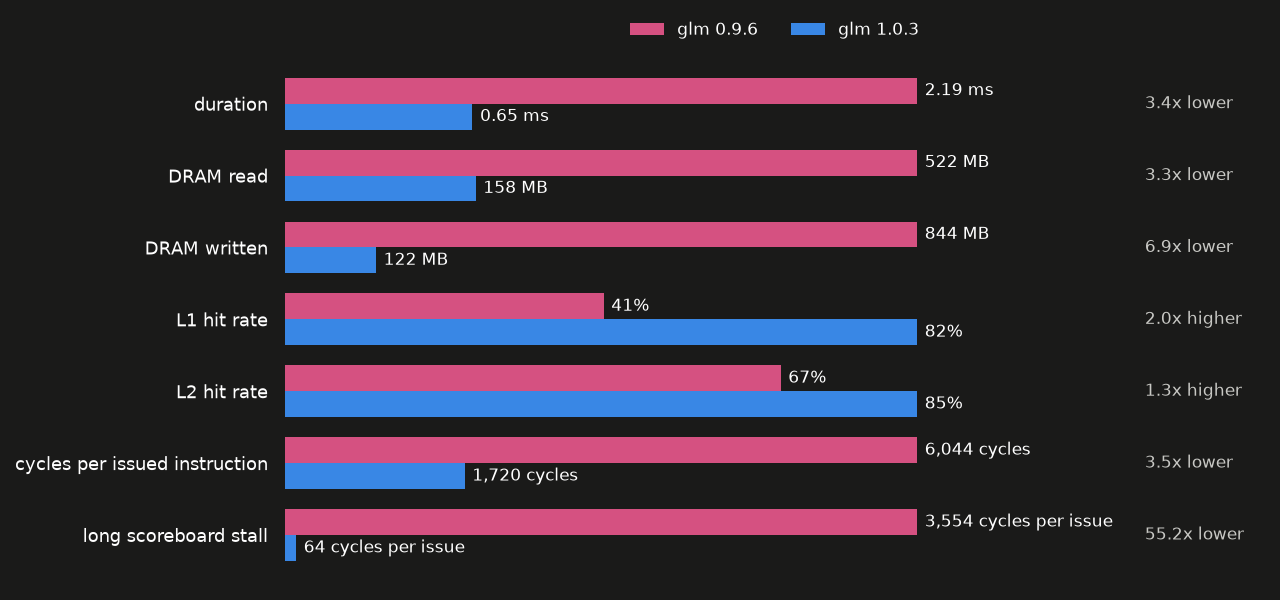
Upgrading glm to 1.0.3, whose operator= is = default, makes the structs trivially copyable again and the gather compiles to 29 loads followed by 29 stores (__restrict__ on the pointers gives the same code with the old glm). A static_assert next to the kernel keeps it that way.
Headless, 1024x1024 (Stardust 1720x720), 100 spp, the sort stage per sample from one --timing run per bar:
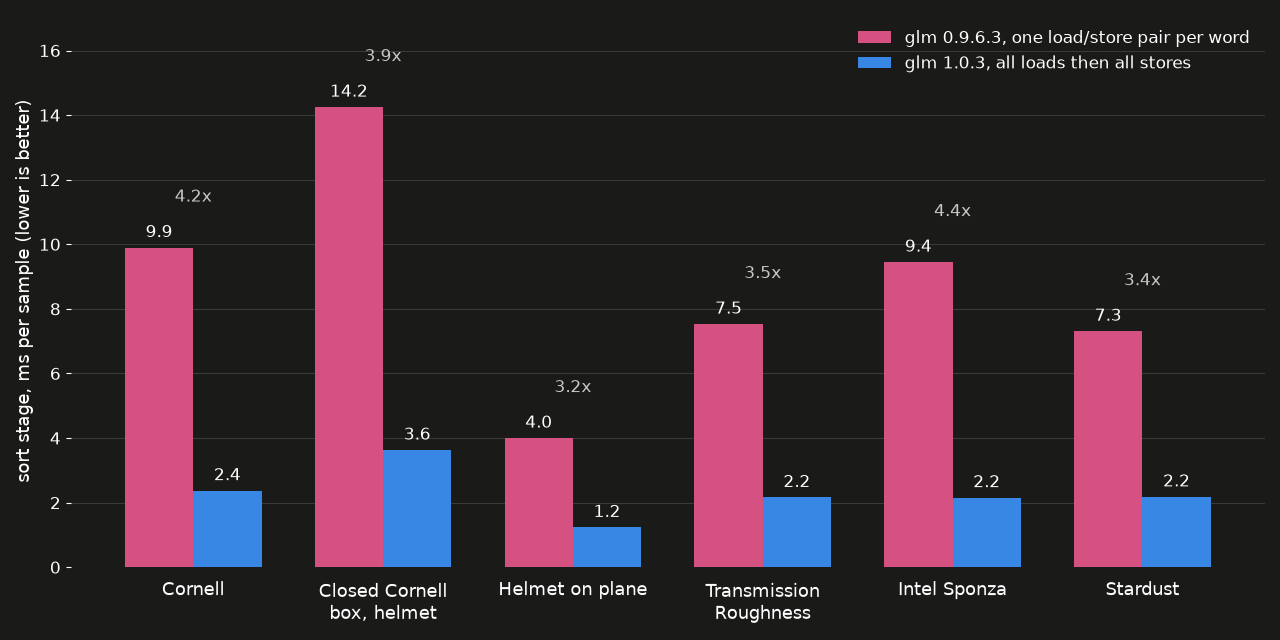
What is left is the move itself: after the sort, a warp’s 32 lanes read 32 structs at least 56 bytes apart, so every load touches 32 sectors for 128 useful bytes, about three times the cost of a contiguous copy. That is more than the shade kernel gains, so the sort stays off.
Why sorting cannot win here
Two things cap what the sort can give back.
- All the sort can do is remove divergence from the shade stage, but sorting literally costs more than shading itself. Even removing every bit of divergence would not cover it.
materialIDis not what the warps diverge on.shadeMaterialbranches on miss or hit, but misses get removed a stage later by compaction anyway. Then insidescatterPbr, warps diverge on which lobe to sample: clearcoat, metal, glass, etc. Every one of those picks compares a random number against a material parameter. Even for materials with no mixing, like roughness 0 and metallic 1, thespecularFactorstill introduces divergence to mix between clearcoat and the diffuse base by Fresnel fraction.
What materialID sorting does win is texture sampling, which is presumably why texture-heavy scenes like Sponza and Stardust get back a tiny bit of performance in shading.
Unless material evaluation gets very complicated (like complex shading graphs in Blender), I don’t think material sorting will ever be worth it in this path tracer.
Issues and bloopers along the way
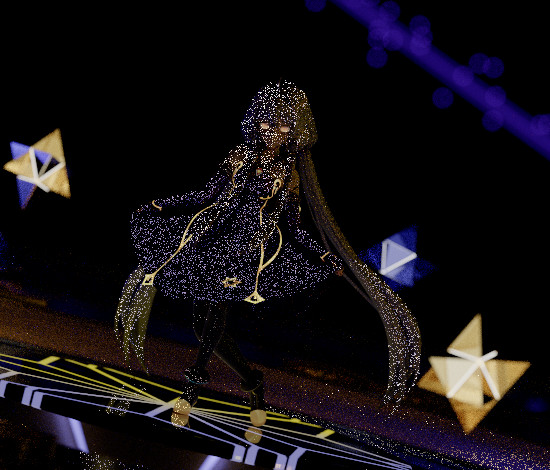
Light linking with one pick table speckled the character
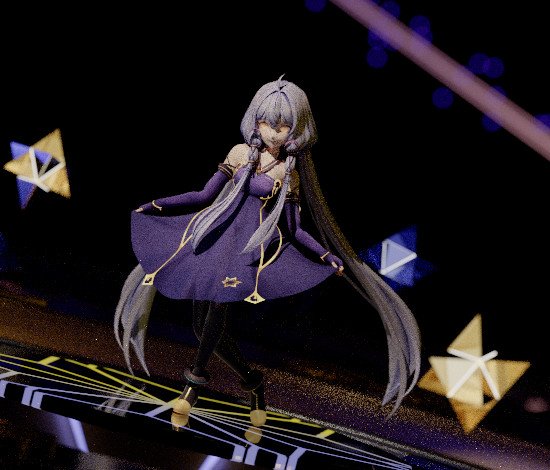
The first version of light linking kept the one global pick table and dropped the samples whose receiver was not linked to the picked light. In Stardust a very bright light is linked away from the character, while a much dimmer spot lights it, so 99% of the character’s light picks were discarded. The few picks of the spot each carried its full contribution divided by a tiny probability, hence the bright specks. The per-mask pick tables give the bright light a probability of 0 in the character’s table, and the same 2048 spp render is clean.
Character crop at 1x, 2048 spp:
| One global pick table | One table per receiver mask |
|---|---|
 |  |
Sponza’s dirt decals rendered as solid walls
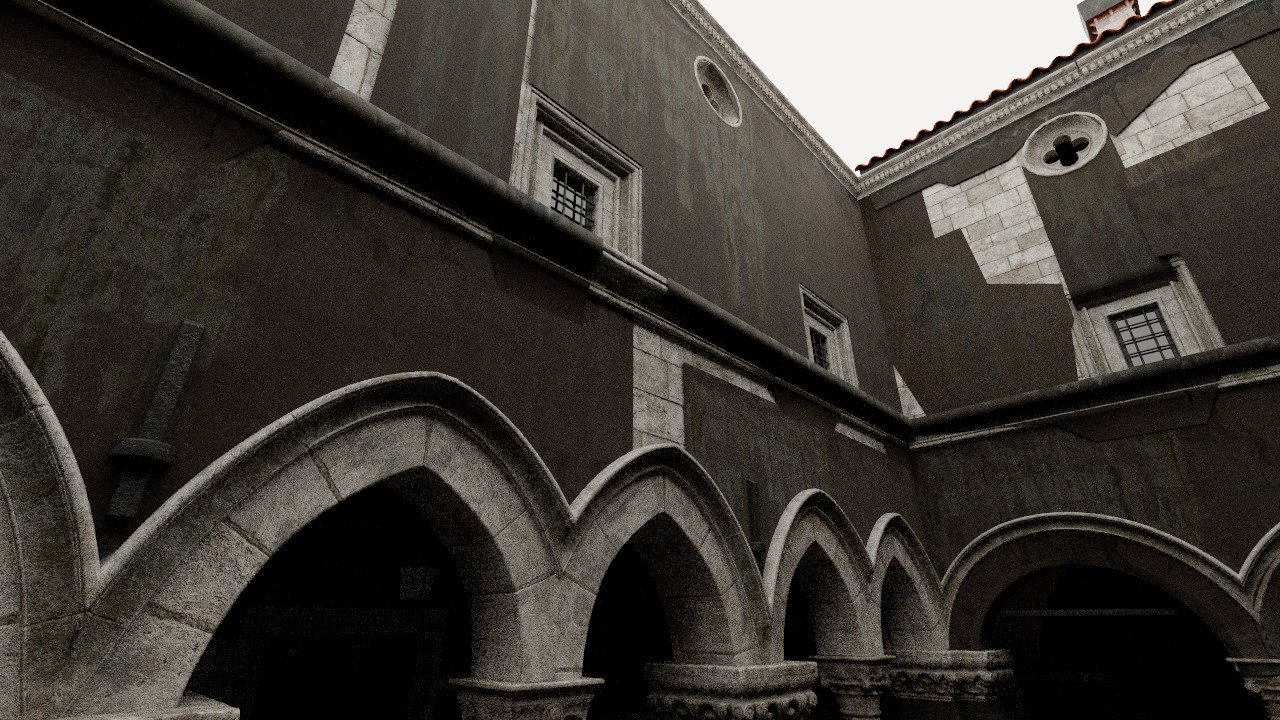
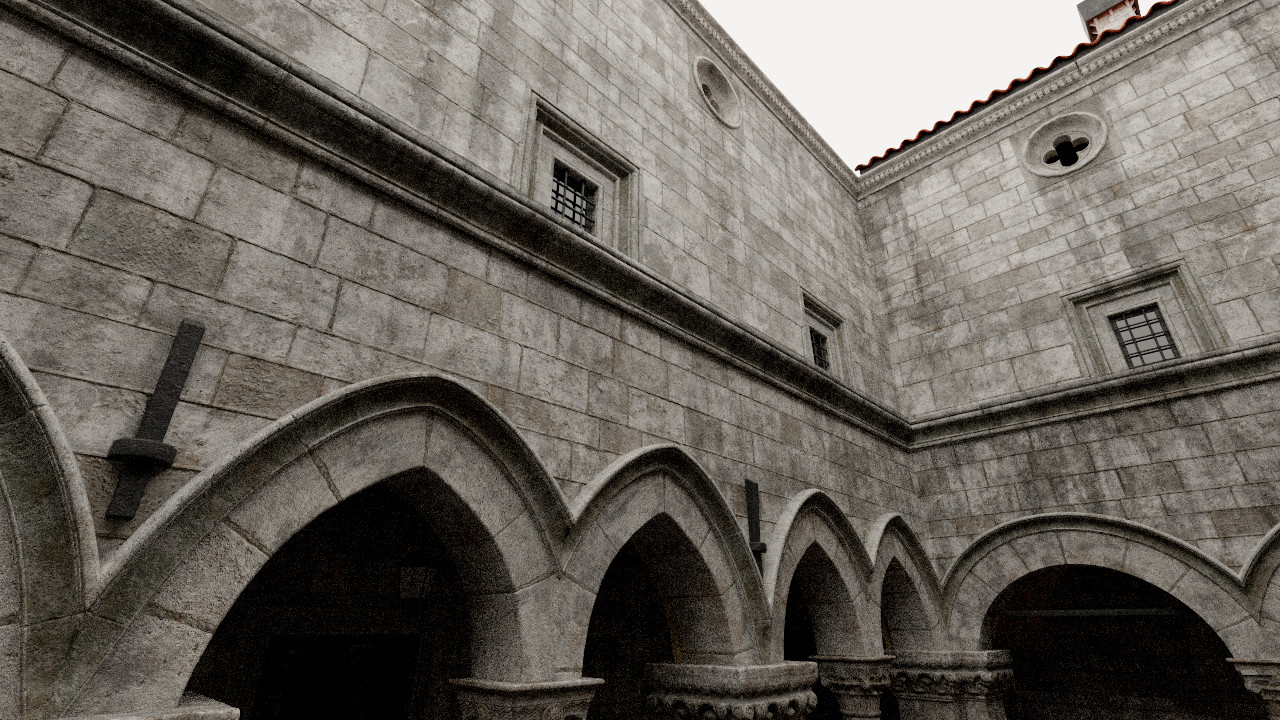
Intel Sponza’s walls carry a dirt_decal material with alphaMode: BLEND, which the loader treated as opaque, so the dark grime texture covered the walls. A BLEND hit now counts with probability alpha, from a hash of the pixel, iteration, depth and triangle, so both intersection paths make the same decision.
| BLEND as opaque | BLEND as coverage |
|---|---|
 |  |
glm 1.0 compiled to garbage on the device
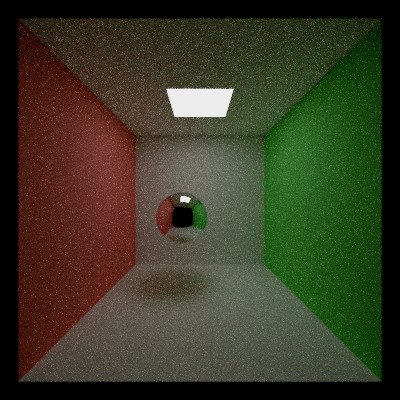
The first build with glm 1.0.3 (why it was upgraded) rendered every scene black, with every path ending on the first bounce on both intersection paths. glm 1.0 routes vector arithmetic through std::plus, std::multiplies and friends, constexpr host functions, and nvcc 13.3 will not call those from device code unless --expt-relaxed-constexpr is set. Instead of an error it prints warning #20013 per instantiation and compiles the call to nothing: on the GPU, glm::vec3(1, 2, 3) * 2.f came back as (1, 2, 0) and glm::dot as NaN, so every camera ray missed. The flag is now on every nvcc command, including the OptiX IR one. Renders after the upgrade differ from the old ones by float drift only: single pixels off by one count, and a few fireflies that moved because a branch flipped on the last bit.
| glm 1.0.3 without the flag | with --expt-relaxed-constexpr |
|---|---|
 |  |
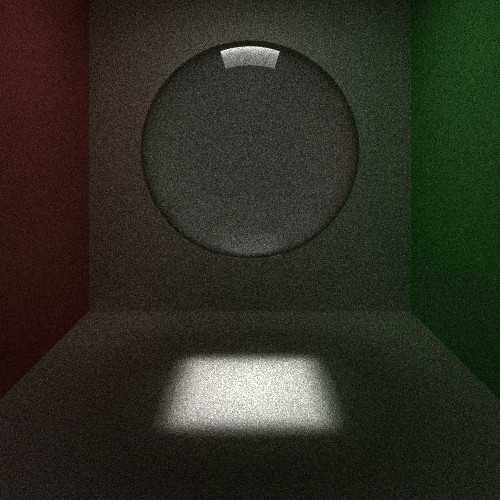
Schlick used the wrong cosine on exit
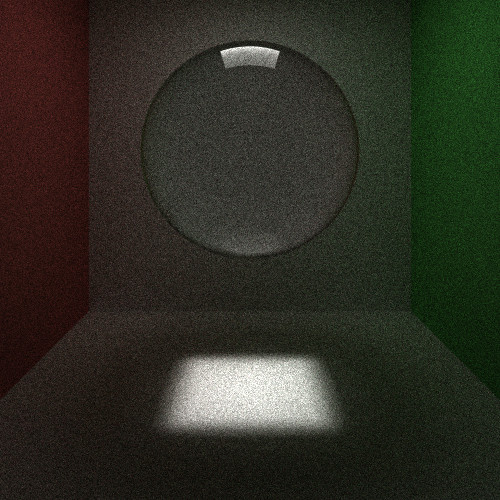
Schlick’s approximation needs the cosine on the air side of the interface, which for a ray leaving glass is the transmitted angle. The base code used the incident one, so reflectance did not reach 100% until 90° instead of the critical angle (about 42° for IOR 1.5), and exit rays just below critical leaked out instead of reflecting back inside. The fix uses the transmitted cosine and treats k < 0 as total internal reflection.
1000x1000, 500 spp, DEPTH 8, cropped to the sphere:
| Before | After |
|---|---|
 |  |
Pixel difference, amplified 8x:
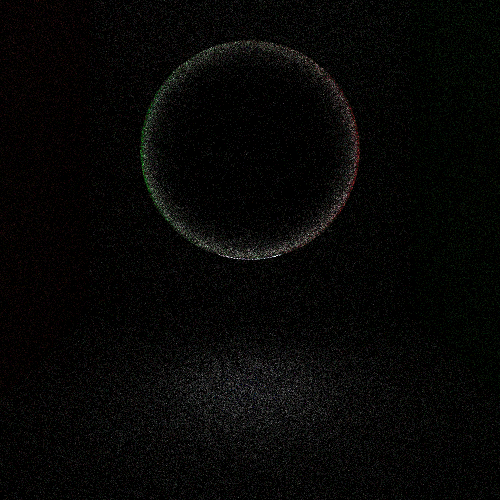
The fixed image is slightly darker at the rim: that light now stays inside for more bounces, and at depth 8 some of those paths hit the cap. Interestingly, raising DEPTH to 32 brightens the sphere by a decent amount, far more than the bug’s influence, so glass just needs a much higher depth than diffuse.
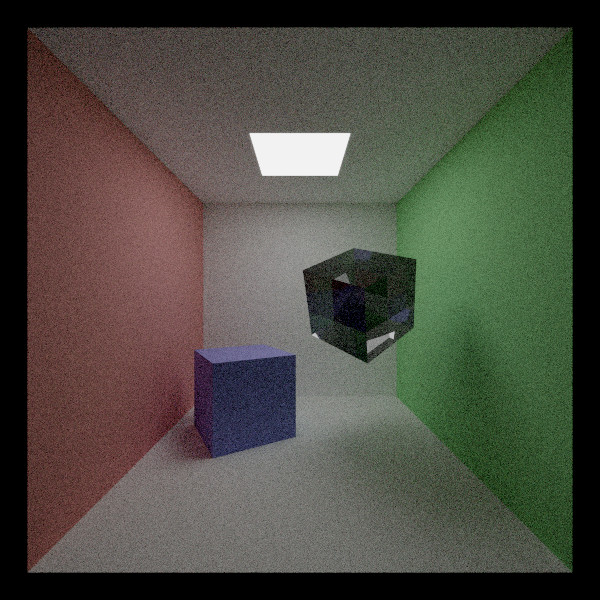
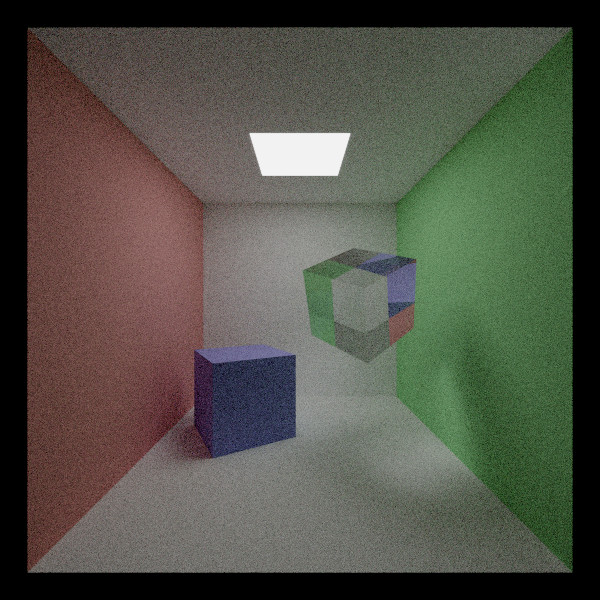
The OptiX cube kept the outward normal on exit hits
The OptiX cube hit program returned the face’s outward normal on exit hits, where the naive boxIntersectionTest returns the normal facing the ray. Nothing in Cornell starts a ray inside a cube, so it only showed once a glass cube came out dark under OptiX. One sign flip on the inside branch fixed it.
600x600, 1000 spp, DEPTH 8, AgX, OptiX:
| Outward normal on exit | Normal facing the ray |
|---|---|
 |  |
Smaller base code fixes
- Every camera move freed and reallocated all device buffers. Buffers are now allocated once; a camera change clears the image.
- The accumulation buffer was copied to the host every iteration so the S key could save at any time. The copy now happens inside save.
- A CUDA error waited on
getchar()before exiting, which hangs a headless run. Removed.
Credits
Test assets
| model | triangles | credit |
|---|---|---|
| Box | 12 | Cesium, 2017, CC BY 4.0 |
| Duck | 4,212 | Sony, 2006, SCEA Shared Source License 1.0 |
| Suzanne | 3,936 | Norbert Nopper / UX3D, 2017, CC0 |
| DamagedHelmet | 15,452 | theblueturtle_, 2016, CC BY-NC 4.0; glTF rebuild by ctxwing, 2018, CC BY 4.0 |
| Sponza | 262,267 | Crytek (Frank Meinl), CryENGINE Limited License Agreement, glTF conversion from the Khronos repo |
| TransmissionRoughnessTest | 77,792 | Ed Mackey, Analytical Graphics, 2021, CC BY 4.0 |
| DragonAttenuation | 134,995 | Dragon: Stanford Computer Graphics Laboratory, 1996, converted by Morgan McGuire, 2017, Stanford Graphics Library license; cloth backdrop: Adobe, CC0 |
| ClearCoatTest | 37,116 | Ed Mackey, Analytical Graphics, 2020, CC BY 4.0 |
| Intel Sponza, main and curtains | 3,747,018 + 1,997,366 | Frank Meinl and Anton Kaplanyan, Intel, 2022, CC BY 4.0; curtains add-on by the Sponza Addon Package Crew |
| Bistro exterior | 2,829,226 | Amazon Lumberyard, July 2017, CC BY 4.0 |
| Bistro interior | 1,043,077 | Amazon Lumberyard, July 2017, CC BY 4.0 |
Models from the Khronos glTF-Sample-Assets, the Intel Sample Library and NVIDIA’s Open Research Content Archive.
Third-party code
tinygltf 2.9.7 (MIT), MikkTSpace (zlib), tinyexr 1.0.13 (BSD-3-Clause), OptiX 9.1.0, stb_image 2.30, Thrust and CUB from CUDA 13.3, and glm 1.0.3. GLFW, GLEW, nlohmann/json, Dear ImGui and stb_image_write came with the base code.
References
- Veach 1997: Eric Veach, Robust Monte Carlo Methods for Light Transport Simulation, PhD thesis, Stanford University, 1997.
- Walter et al. 2007: Bruce Walter, Stephen R. Marschner, Hongsong Li, Kenneth E. Torrance, “Microfacet Models for Refraction through Rough Surfaces”, Eurographics Symposium on Rendering 2007.
- Dupuy and Benyoub 2023: Jonathan Dupuy, Anis Benyoub, “Sampling Visible GGX Normals with Spherical Caps”, High-Performance Graphics 2023.
- Karlík et al. 2019: Ondřej Karlík, Martin Šik, Petr Vévoda, Tomáš Skřivan, Jaroslav Křivánek, “MIS Compensation: Optimizing Sampling Techniques in Multiple Importance Sampling”, ACM Transactions on Graphics 38(6), SIGGRAPH Asia 2019.
- PBRT-v4: Matt Pharr, Wenzel Jakob, Greg Humphreys, Physically Based Rendering: From Theory to Implementation, 4th edition, MIT Press 2023.
Tools Used
CUDA, OptiX, C++, OpenGL, GLFW, Dear ImGui, CUB, CMake